Build a Meeting Prep Packet
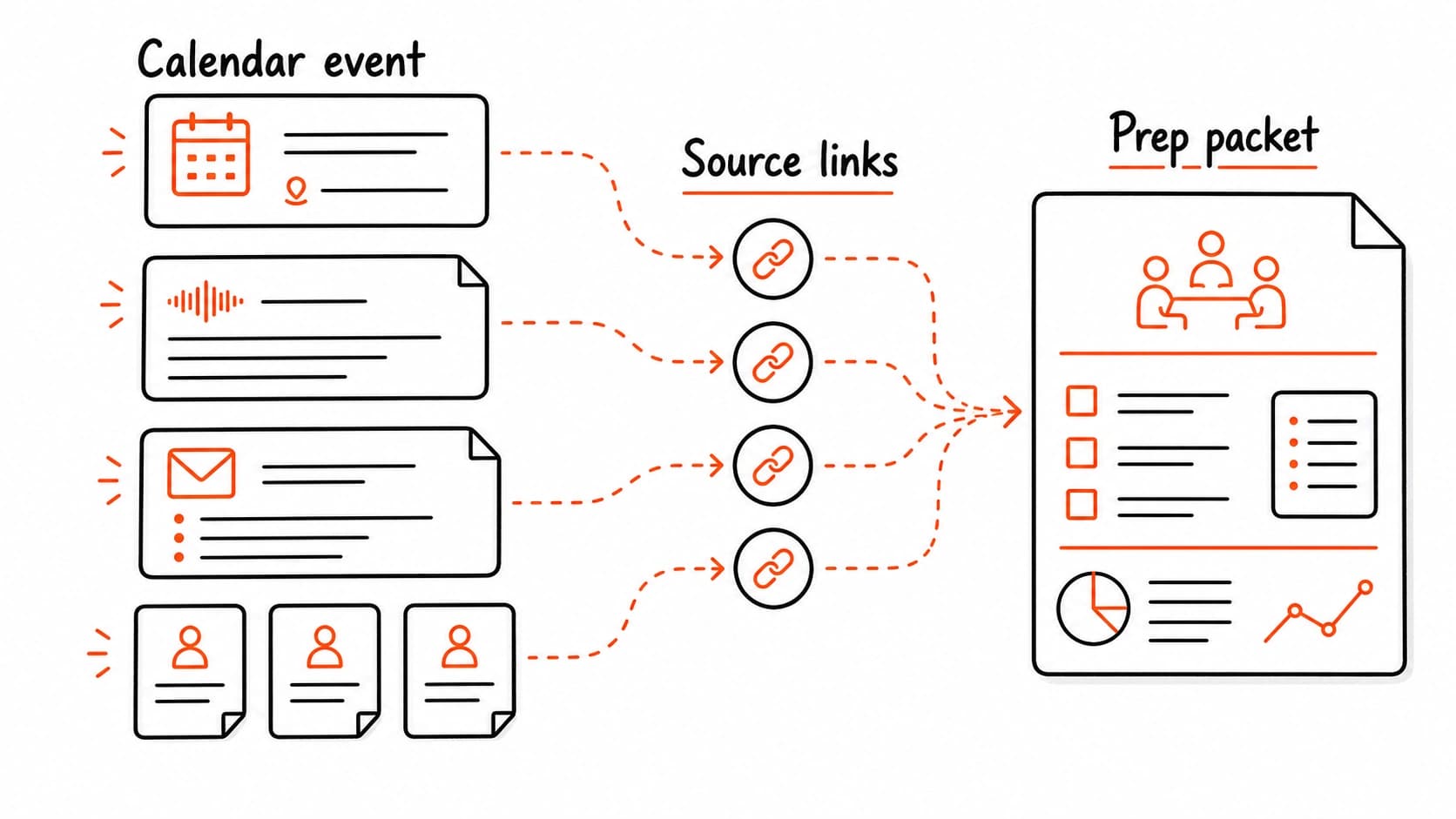
The previous chapter connected three sources for Thursday's client call: the , the follow-up email, and the calendar event. You extracted decisions, commitments, and open questions, and the AI filed them under . The records exist, but they live in separate places. This chapter pulls them together into one artifact you can open before the next call.
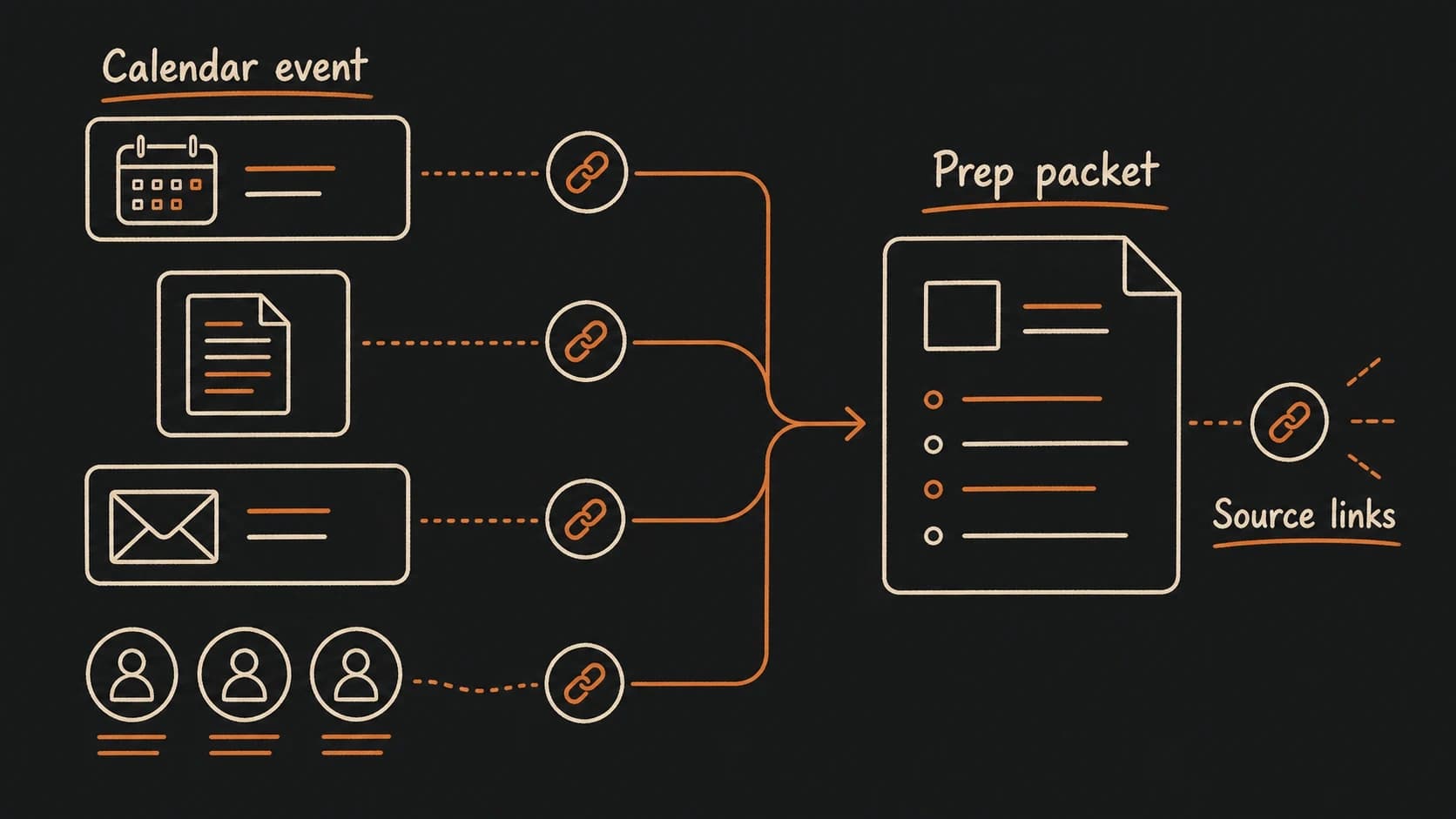
A meeting prep packet is the simplest useful thing your can produce. It answers one question: what do I need to know before I walk in? The attendees. The last decision. The open question nobody resolved. The someone made. The follow-up you owe. Each item links back to the source that supports it, so you can verify anything before the call starts.
One page carries everything the next call needs
A prep packet for a recurring meeting has six sections. You do not need all six for the first version. Start with whatever your sources already support, and fill the rest as records accumulate across calls.
Assemble the Thursday call prep from existing records
You already have the pieces. The from May 8 holds two approved decisions: pilot the intake form with two clients, and delay the pricing update. The follow-up email from May 9 shows Renee's tentative Friday for the draft agenda. The calendar event lists four attendees. One open question remains, whether legal review finishes before the pilot starts.
Put them on a single prep page. At the top: meeting date, attendees, project name. Below that: the approved decisions with source links to the . Then Renee's , marked tentative with a link to the email. Then the legal question, marked unresolved with a link to the . At the bottom: every source link with its date and .
The result is a one-page briefing you can read in three minutes before the call. Every claim points to a source. Every carries its strength, confirmed or tentative. Every open question names what would resolve it. Here is what the finished packet looks like.
# Prep Packet: Client Onboarding Pilot — May 16

## What changed since last call
- Pilot scope is still approved for two clients.
  Source: May 8 meeting record. Trust: reviewed.
- Client asked about expanding to four clients.
  Source: May 9 follow-up email. Trust: reviewed, tentative.

## Decisions to confirm
- Has the scope formally changed from two clients to four?

## Commitments
- Renee: draft agenda by Friday.
  Strength: tentative.
  Source language: "I'll try to send the draft agenda by Friday."

## Open risks
- Legal review may block the May 20 start date.
  Source: May 8 meeting record. Status: unresolved.

## Sources cited
- May 8 meeting record (reviewed)
- May 9 follow-up email (reviewed)
- Project brief, last reviewed May 12
Use that shape for your own recurring call. Each section is optional in the first version; fill only what your sources already support. The packet becomes more useful as records accumulate across calls.
A prep packet looks forward; a summary looks back
A summary tells you what happened. A prep packet tells you what matters for the next conversation. The difference shows up in what each one includes. A summary of Thursday's call would describe the full discussion, the tangents, the small talk, and the administrative details. A prep packet keeps only the items that affect the next call and links each one to a source you can check.
If someone asks "when did we decide that?" during the meeting, the prep packet should let you answer with a source link instead of a memory. That is the test. A prep packet without source trails is a polished guess you cannot verify under pressure.
Person makes the packet more useful over time
As the prep packet accumulates across calls, one section grows increasingly valuable: person for each attendee. Renee prefers written confirmation before she considers a deadline firm. Sam raises concerns at the end of meetings when everyone is ready to leave. The client asks about scope changes in the first five minutes. These preferences rarely surface in a single , but after three or four calls, the pattern becomes clear.
Add a person section to the prep packet when you notice a recurring pattern worth preserving. Keep it short: one or two observations per person, each linked to the call where you first noticed it. This section is a resource that grows across meetings. The rest of the packet resets each time.
Keep the prep packet current between calls
A prep packet goes stale between meetings. A decision changes in an email. A gets confirmed or withdrawn. A new question appears. The prep packet should be a living document that updates when new sources arrive, not a static snapshot created once after each call.
The simplest update rhythm: after every significant source (email, message, or note) related to the meeting, add the new information to the packet and mark which existing items changed. During the , verify that the packet still reflects reality. Before the next call, read the packet and check one source link to confirm the system is current.
Build a meeting prep packet
Claude reads your second brain and assembles the brief. You tell it what matters.