Becoming an AI Power User
Becoming an AI Power User
286 min leftPage 67 of 223 (est.)
1.11The Expanding Edge
They climb from doing AI tasks step by step to directing them, delegating the work they know how to check
Developing

Turn a hunch into a check an AI result can pass or fail
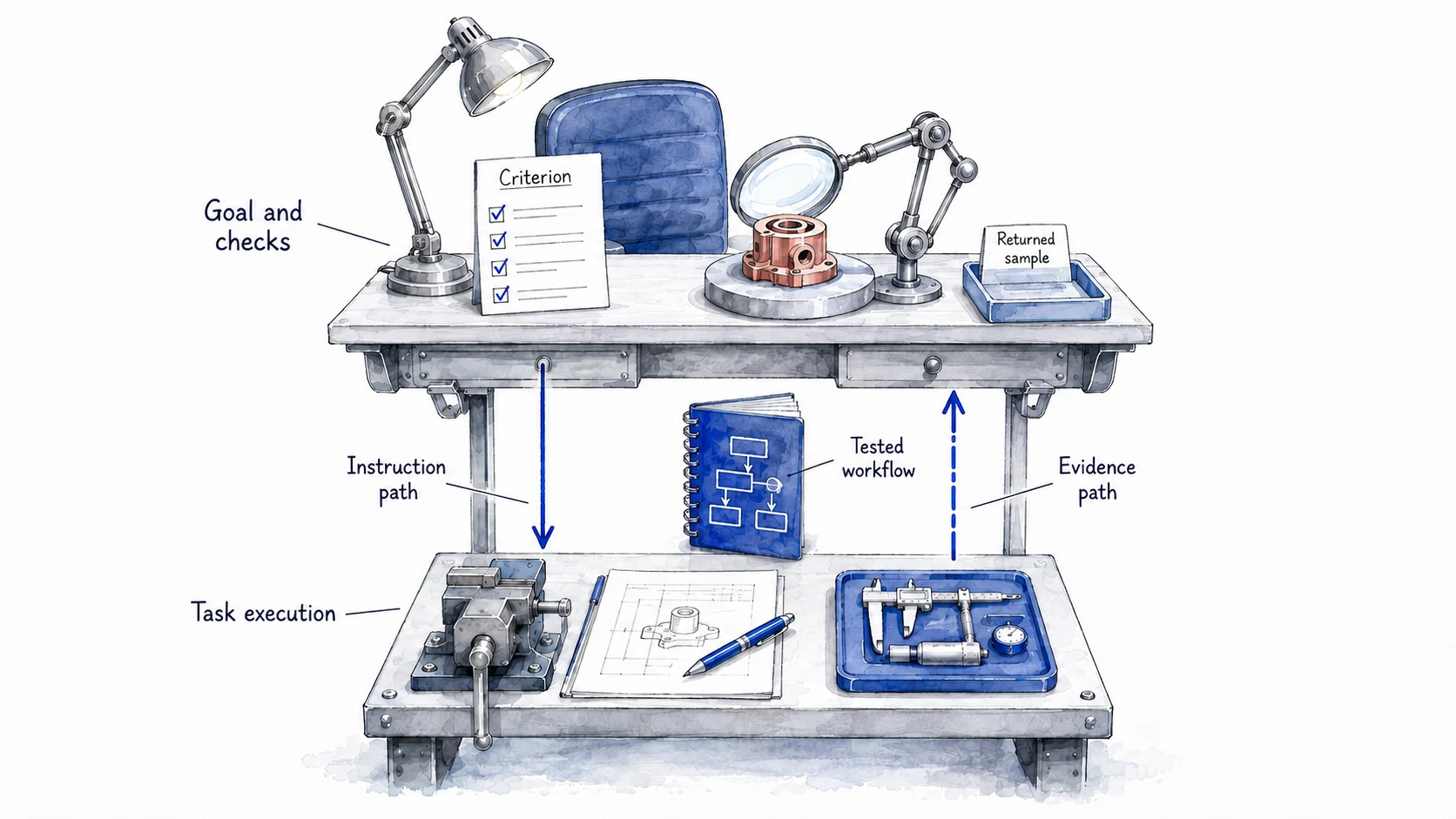
The checks are what let you step back from the work, so they need to be sharp. There are several ways to learn what a task requires: doing it yourself, studying good examples, asking an expert, or testing an AI draft. Whichever route you take, aim for a criterion that a result either meets or fails. For the morning brief: "Show any deadline that overlaps an appointment, with links to both entries." One glance at the day's calendar tells you whether the brief met it.
Some criteria are hard to reach because you apply them without ever stating them. Say a brief that lists your day in time order feels wrong, and it takes a minute to work out why: the one decision you have to make before 9:00 is buried in the middle of the list. , examining your own goals, expectations, and strategies, is how a feeling that something is off becomes a criterion someone else can apply. Here the criterion is "Put anything I must decide this morning at the top." Ask the assistant to help you put an expectation like that into words, then point to the line of its next brief that satisfies it.
Asked to interview you and compare your examples, the assistant may spot a distinction you had missed. It may also infer a preference you do not hold. If your three favorite briefs happen to be short, it might propose "Keep the brief under five lines," when their length was an accident of quiet days. Read each proposed criterion against your purpose and your examples before it goes into a standing instruction.
Prompts, templates, workflows, and supervised processes each hand AI more of a task
A task can be handed over in four forms: a prompt you write each time, a template you fill in, a workflow of connected steps, and a process that runs on its own under supervision. Each one gives the assistant a larger share of the work and puts more weight on your checks. Choose the lightest form whose behavior your checks cover and whose setup the task repays. Plenty of tasks never need more than a prompt, and a workflow someone else has already tested can be your starting point.
A single AI prompt takes the least setup to experiment with
Nothing is fixed yet, so each attempt takes little setup. Ask for a morning brief, compare it with your calendar, move the deadlines to the top, try it as a table, ask for it in the voice of a sports commentator. Each version teaches you something about what you want the brief to do. When you catch yourself pasting the same instructions three mornings in a row, they are ready to save.
A prompt template keeps what repeats and asks only for what changes
A template holds the instructions, the context each run needs, the quality criteria, and the output format, with blanks for what changes, such as the date. To build one, give the assistant three briefs you found useful and ask it to write the instructions they share. It might propose: read today's calendar and deadline list; list any deadline that falls inside an appointment, with links to both entries; then list the rest of the day in order. Compare what it inferred with your reasons for choosing those examples, then try the template on a day with no meetings and on a packed one.
An AI workflow has to report a broken handoff between steps
A workflow connects steps, and each step hands its output to the next. One step retrieves the calendar, a second drafts the brief from those entries, and a third compares the draft with the entries. If retrieval fails, the workflow should stop and say "Calendar unavailable" before anything downstream writes a confident brief about an empty day. If the check finds a wrong time, it should send the draft back for revision. Test those failure paths along with the ordinary run.
Set the limits before an AI process runs on its own
With the right tools connected, an agent or a scheduled job can run the workflow at 7:00 every morning. Before it runs unattended, decide what it may read or change, what it must check, and what it should do when a source fails or a decision goes beyond its authority. For the morning brief, it might read the calendar and the deadline list, change nothing, and propose moving a call but leave rescheduling it to you. Test those limits the same way you tested the brief. As the runs hold up, your attention moves from running the process to improving it.
Hand AI the parts your checks cover and keep the parts that need your judgment
A delegated process without adequate checks repeats its early mistakes every time it runs. Suppose the brief opens with "Renew the parking permit" every day for a week, because nothing in its criteria separates what is due today from what is due next month, and nobody reads closely enough to object. Inspect the failure, ask the assistant to propose the missing criterion, such as "Order items by when a decision is due," and test the revised process on several days. Your own digging, source checks, and the assistant's diagnosis can each help find the repair.
A task is ready for delegation when its goal, required information, constraints, failure checks, and limits of authority are written down, and tests show the process performing acceptably on the cases it will meet. The assistant can help write that description. The evidence can come from source checks, automated tests, domain experts, or a second AI reviewer whose verdicts you have compared with your own.
Keep your hands on the parts where your involvement improves the result, or where you enjoy the work. Delegate where the handoff frees you for a larger task. Add a new level when it solves a problem you have run into: a saved brief might free the attention you need to plan your week, or it might be all you ever want from your calendar.
A tested daily AI brief becomes one step of a weekly plan
The request "Show what needs attention before my first meeting" can now start a workflow that retrieves your records and checks for conflicts. Once that workflow holds up, its daily output can become one step of a larger task.
Say it is Sunday evening and you want a plan for the week. Five morning briefs would show what needed attention before each day's first meeting, and nothing about the report you mean to start drafting or the afternoon you want for reading. Weekly planning needs inputs the daily brief never touched: the whole week's calendar, your current project goals, and the deadlines coming up over the next two weeks. Ask the assistant to gather those and propose where your open hours could go. It might suggest Tuesday from 1:00 to 4:00 for the report, since Wednesday and Thursday are packed with meetings. Then check the plan. Does every fixed commitment stay where it was? Does the report still get time, even though nothing on the calendar mentions it? If the assistant can reschedule meetings, does it stay within the authority you gave it? The broader goal needs its own context and its own tests. The daily brief arrives as a dependable part, and the weekly plan still has to show that it serves your priorities.
A useful abstraction keeps the distinctions that matter while sparing you the repeated execution. The goal holds steady while the implementation changes underneath it. Whether the assistant reads records you paste in or retrieves them through a connection, you still want the decisions due before your first meeting, and your checks still tell you whether you got them.
This part of the book opened with a small experiment. Your assistant could already list your appointments, so you asked it something harder: does any deadline fall inside a meeting, and what should you deal with first? In that example, the sharper request turned up a proposal due at 10:00 in the middle of a 9:30 call, which you could confirm against your calendar in seconds. That same check can now run inside a process that has held up on ordinary days, empty days, and days the calendar would not load, and that reports only what needs your decision. You read what it found and decide. The edge where you first tried that request has become familiar ground, and your next attempt starts from there: a weekly plan, or something you had not yet thought to ask an assistant for.
Find a task to hand off to AI
Review the AI work you repeat, describe one candidate task clearly, and draft a reusable process with a test plan. You decide whether to try it.
- Copy the promptUse the copy button above the box.
- Paste it in Claude or CodexMake sure your active project is enabled.
- Answer the questionsGive clear answers so it understands what you want made.
- Test it to see if it worksTry the output and refine until it does what you need.
Problem: I repeat some AI work by hand, and I am not sure whether a more elaborate setup would improve it.
Intent: I want to find out whether a recurring task should be saved or delegated and, if it is, draft a process with a test plan.
Use any examples already in this conversation. Otherwise, ask me about AI work where I keep repeating instructions or handoffs: what the task is, which steps I follow, which parts are manual or automated, and where the effort or recurring trouble comes in. Do not assume that I have a stable workflow or that more automation would help.
1. Describe how I handle the task now, using whichever of these fits:
- Prompt: I write each request myself.
- Template: I reuse instructions and fill in what changes.
- Workflow: connected steps, with conditions at each handoff.
- Supervised delegation: a process runs the steps within set limits and checks, and I review what comes back.
2. Pick a promising candidate and explain what it would save and what setup or supervision it would add. If my current approach is enough, say why and stop after this assessment. Otherwise, interview me about the task's goal, inputs, examples of good output, criteria, and known failures. Draft the task description from my answers and any sources I provide. Do not invent my preferences, and do not require me to perform every step by hand first.
3. Draft the reusable form the task needs: a template for repeated instructions, a workflow for connected steps, or a standing instruction for delegated runs. Include the inputs that change, the quality criteria, how failures are handled, and when the process must stop and ask me for a decision.
4. Propose a test plan with representative cases and likely failures. Name the sources, tools, expertise, or reviewers needed to judge the results, and state what the process may read or change. Leave results blank until the tests run.
5. Write a supervision checklist: what to recheck when a model, source, or task changes, and when to revise or simplify the process. If a broader task looks promising, list the extra context, criteria, and authority it would need.
Show the assessment and, when warranted, the task description, proposed process, test plan, and supervision checklist. Mark anything you inferred about my preferences for me to confirm before it becomes a standing instruction. Do not run my workflows or save the process.
References
1 source- 1
John H. Flavell · 1979 · American Psychologist 34, pp. 906–911
Flavell proposed a model in which knowledge and experiences concerning one's own thinking interact with goals, tasks, actions, and strategies. These interactions can help a person monitor and adjust cognitive work. Awareness alone is not the whole mechanism.
Knowing your own goals and strategies helps you explain what a delegated task should achieve. An assistant can support that explanation by asking questions and proposing criteria for you to review.
Flavell studied human learning and cognition, and applying his framework to AI delegation is an extension. It does not show that you must master a task by hand before delegating it, or that describing a task well makes a process reliable.