Becoming an AI Power User
Becoming an AI Power User
358 min leftPage 28 of 223 (est.)
1.5The Expanding Edge
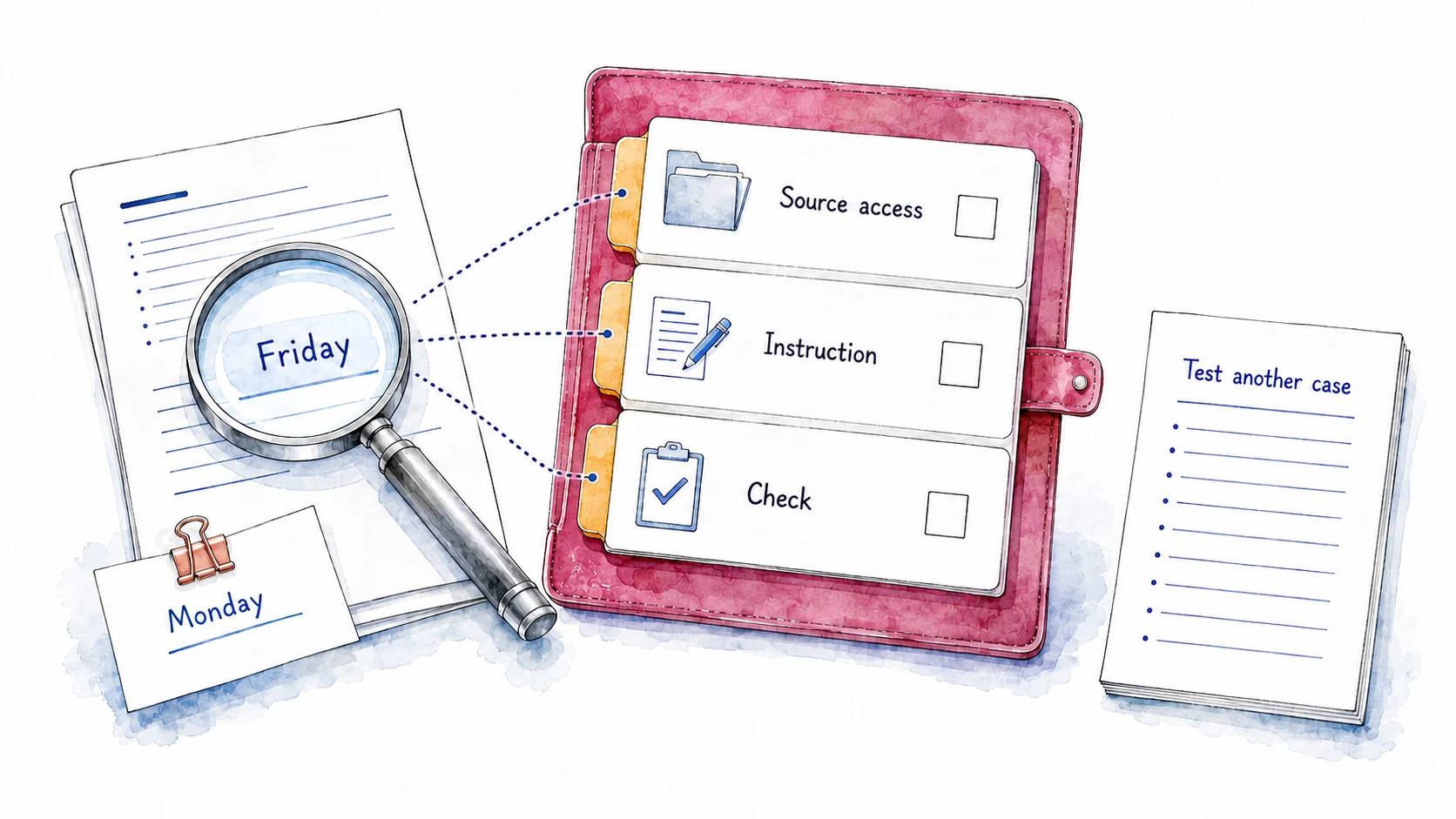
They use meta-prompting to have AI improve the instructions, sources, and checks behind its output
Developing

To find out which cause applies, give the assistant the request, the draft, and the notes, and ask: "Where did Friday come from? Show what in my request or the sources supports it, and keep that evidence separate from your guesses about the cause." If it never received the notes, the repair is access, and no rewording will supply notes it cannot read. If it read the notes and still wrote Friday, look at the instruction and at whether anything checked the draft.
Every question so far improves the way the email is written. Some questions go further. Chris Argyris and Donald Schön called this . corrects errors within the goals you already hold. asks whether those goals are right. For the client email, a single-loop question is: "How do we make the date match the notes and explain the slip clearly?" A double-loop question is: "Does the client need an explanation of the slip at all, or a revised schedule they can approve?" The second question changes the assistant's job. Instead of polishing an apology, it lays out the Monday delivery and anything that moves because of it, and asks the client to approve the new dates. Rewording a prompt, however carefully, stays in the first loop until someone questions the purpose.
Pick the question that fits what went wrong or right
Each question below looks at one part of a task's setup. Paste the one that fits, along with the original request, the result, and what you thought of it.
- When the wording may be unclear: "Which parts of my request could be read more than one way, and which of those readings would change your answer?"
- When context may be missing: "What facts or preferences would change your answer? Which can you look up in the sources you have access to, and which do you need from me?"
- When you need a way to judge the result: "What separates a strong answer from a weak one for this task? Which of those standards can be checked against the sources, and which take judgment?"
- When a result failed: "Which requirement did this result miss? For each possible cause, what evidence supports it, and what test would tell the causes apart?"
- When a result worked and you want it again: "Which steps, sources, and checks produced this result? Write them up as a workflow I could run on the next case, and mark which parts you inferred."
One question often leads to another. Missing context can change the prompt, a clearer standard can suggest a review step, and now and then the investigation shows that the task needs fewer steps than you gave it.
works backward from a message you admire
starts from a result you admire and works backward to instructions that could produce more like it. You ask the assistant what makes the result work and what instructions might bring out the same qualities in a similar task. Many different prompts could produce a similar result, so what comes back is a candidate to try. It does not recover whatever prompt, if any, produced the original.
Suppose a colleague sent an update about a team offsite that was easy to act on. It read: "Decision needed by Thursday: book the larger room for $400 more, or cap attendance at twenty. Everything else is on schedule. The catering quote arrived late because the caterer changed its menu; the final menu comes Tuesday." If you ask the assistant what makes it work and have it point to the text, it might list three qualities. The decision comes first, with its deadline and the cost you have to weigh. One sentence covers everything on track. The one exception gets its cause and the date it resolves, with no blame.
Those qualities suggest a candidate instruction: "Open with any decision the reader must make, with its deadline and cost. Summarize what is on track in one sentence. For each exception, say what changed, why, and when it resolves." Try it on a week when three things slipped at once. A good instruction gives each slip its own cause and resolution date and does not fold them into one reassuring sentence. The example shows how your colleague writes, so borrow its structure and keep your own voice.
Spend prompt-revision effort where the AI mistake keeps coming back
Improving a reusable prompt takes time you could spend on the task itself. For a weekly client email, fixing the setup once can spare you the same correction every week. A rare task can still justify the investigation when a mistake would be costly, such as a wrong figure in a contract. A one-off, low-stakes draft usually needs only a direct fix. Weigh how often the problem will return and what it costs when it does.
The first prompt below works on a result that fell short. Run it in the conversation that holds the exchange, or paste in the request, the result, and your sources. The second works from something that went well, such as an AI exchange or a message you admire. Bring the example, say what you like about it, and try the instructions it produces on a different input before you save them.
Find what to change behind a recurring AI task
The assistant reads a recent exchange, picks the questions that apply, drafts one change, and plans a test on a different input.
- Copy the promptUse the copy button above the box.
- Paste it in Claude or CodexMake sure your active project is enabled.
- Answer the questionsGive clear answers so it understands what you want made.
- Test it to see if it worksTry the output and refine until it does what you need.
Problem: A task I run with AI keeps needing the same corrections, or a recent result fell short and I want to know why.
Intent: I want to find what in the setup to change and draft a change to test.
Use the original request, the output, and any sources already in this conversation. If any are missing, ask me for them, and ask what the result was supposed to accomplish, what worked or fell short, and how I know. Use my answers before you continue. Do not rerun the task or save anything.
1. Confirm the goal. Ask about gaps that would change your diagnosis. Tell me whether the problem looks like the method or whether the goal itself may need rethinking. Do not change my goal on your own.
2. Choose the questions that apply: unclear wording, missing context, unclear standards for a good result, a failure to diagnose, or successful steps to reuse. Explain your choice from the evidence, and skip the ones that do not apply.
3. Draft the change: a prompt, a source instruction, a list of standards, or a workflow. One sentence may be enough. Use only facts and preferences I have stated, and mark anything you inferred about me for my confirmation. Have any reusable instruction ask for the input that changes from one run to the next.
4. Propose a test on a different input. Say what would count as improvement, which existing strength must survive, and which failure the test should catch. Keep the original version for comparison, and leave the results blank until I run it.
Return the evidence, the proposed change, and the test. If a different source, tool, or approach would help more than another prompt revision, say so.
Work backward from a result you admire
The assistant lists what makes the example work and drafts instructions to try on a different task.
- Copy the promptUse the copy button above the box.
- Paste it in Claude or CodexMake sure your active project is enabled.
- Answer the questionsGive clear answers so it understands what you want made.
- Test it to see if it worksTry the output and refine until it does what you need.
Problem: A result I admire has qualities I have not yet put into words.
Intent: I want instructions that could bring out those qualities on a different task.
Use the example and my explanation already in this conversation. If either is missing, ask me to paste or attach the result I admire and say what I like about it. Ask what kind of task I want to use the instructions for. Use my answers before you analyze anything. Do not write a new version of the example or save anything.
Return these sections:
1. STANDARDS: List the qualities observable in the example, with the details that show each one. Keep what I said I like separate from your own interpretation.
2. PROMPT: Propose a prompt that could bring out those qualities on another task. Have it ask for the source material and requirements that change with each use. Keep observed qualities separate from inferred instructions, and do not claim to have recovered the original prompt.
3. PRINCIPLES: Suggest broader principles that may explain why these qualities work. Tie each one to the example and state its limits, since a single example cannot prove a general rule.
4. WHAT TO REUSE: Propose one instruction or example to test, and describe a different input that would show whether it transfers. Include one case where copying the example's approach would be a poor fit.
Work only from the example and my answers. Another author's writing is an example to study, not evidence of my own voice. If you propose a reusable personal voice or preference, ask for my own writing, show the evidence behind the proposal, and get my confirmation before saving it in any later step.
References
1 source- 1
Chris Argyris · 1977 · Harvard Business Review, September–October 1977, pp. 115–125
Single-loop learning corrects errors while retaining governing objectives and assumptions. Double-loop learning examines and can revise those objectives or assumptions.
When revising an AI workflow, ask whether the method served the stated goal and whether the goal served the reader's need. Changing a prompt's wording can improve execution without changing the underlying objective.
The distinction comes from organizational learning. Applying it to AI prompting is an editorial lens here, not a measured claim that meta-prompting produces a particular improvement. Additional source: Chris Argyris and Donald Schön, Organizational Learning (1978).