Becoming an AI Power User
Becoming an AI Power User
365 min leftPage 24 of 223 (est.)
1.4The Expanding Edge
They reject AI slop, polished output that says nothing useful, and keep the standards that catch it
Developing

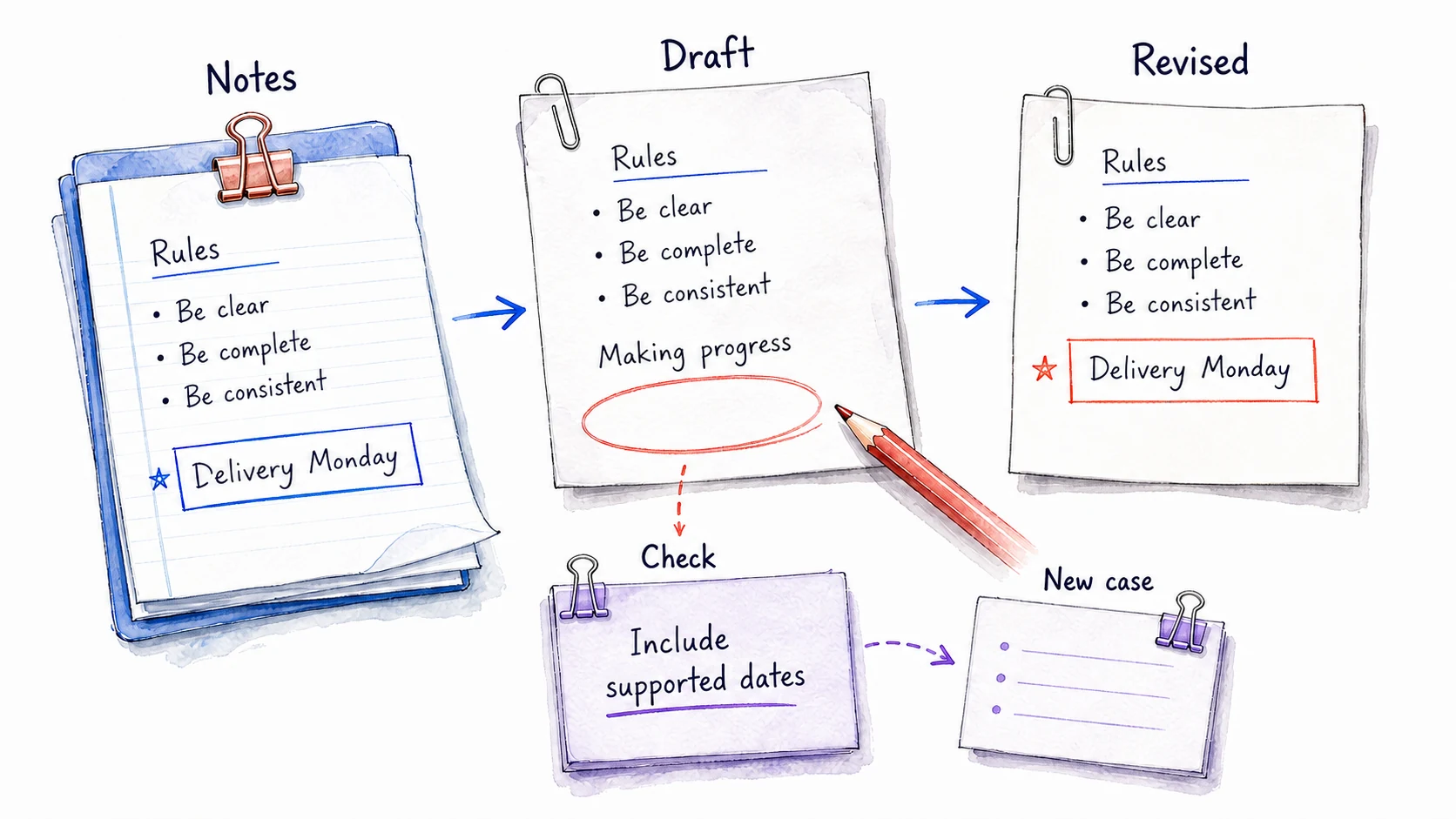
Before asking for a more specific sentence, find out why the date is missing. If Monday is in the notes and absent from the draft, the fix is to put it back. If nobody has set a new date yet, no rewording can supply one. The update should say the date is still being settled and when the client will hear, and you need to ask whoever owns the schedule.
"Be more specific" does little on its own. An assistant asked for details it does not have may repeat the vagueness in longer sentences, or it may make something up. Give it the facts instead: the new date, why the work slipped, and what the client has to decide. Then the draft has something specific to say.
"This sounds vague" is a reaction. "Include the delivery date from the project notes" is an instruction the next draft can follow. The check in the picture takes that instruction one step further: Include supported dates. The word "supported" carries the weight. It asks for the dates the reader needs, each one backed by the notes, and it rules out a date the assistant invents to satisfy the check. Save a correction when it states a standard you expect to need again.
A turns each caught AI flaw into a saved check
A ratchet turns one way and locks against slipping back, like a zip tie or a socket wrench. A does the same for your standards: each time you catch a flaw, you save a check for it, and every later draft has to pass that check. The check, with the failed draft saved beside it, keeps the flaw from creeping back in. It holds only while the checks keep running. Models, sources, and your own instructions change, and a new check can pull against an old one, so rerun the list when something changes.
Plenty of work needs no ratchet. A reminder that the office closes early on Friday or a packing list for a weekend trip should be adequate and fast, and a generic answer delivers that. Generic output becomes when the task needs knowledge of your situation, judgment about it, or a tone fitted to a particular reader. Use enough checks to protect the work and few enough that running them stays quick.
Empty language, generic advice, unsupported claims, and hollow structure make up most AI
Most falls into one of four families. A word for each lets you point at the exact sentence that fails and say why, instead of calling the whole draft weak.
Empty language fills space and says nothing. "We will leverage synergies to drive alignment across workstreams" could sit in any company's update, and nobody who reads it knows what happens on Tuesday. To test a suspect sentence, delete it and ask what the reader lost. If the answer is nothing, it was empty.
Advice without an application is sound in general and silent about your case. Suppose you ask how to prepare for tomorrow's one-on-one with your manager and get "Set an agenda, gather updates, and follow up afterward." Every item is sensible, and none is about your meeting. Point the assistant at your own material instead: "Using my notes from our last two one-on-ones, list what I promised to report on and any question still open." Now the answer can be three specific lines, such as the budget figures you promised, the hiring question your manager put off, and the vacation dates still waiting for approval.
Confidence without evidence states a guess in the voice of a fact. "Most people become power users after about six months" reads like a finding. It has no source, and it replaces learning and practice with a date on the calendar. Any number, date, or cause in a draft needs a source behind it.
Structure without substance borrows the look of analysis. A status update with sections for Risks, Challenges, and Next Steps looks thorough. If all three say some version of "the schedule needs attention," the headings are decoration. Each section should tell the client something different: why the delivery slipped, what that does to their launch, and what they need to decide.
Write short checks and let AI run them
A good check is short, concrete, and traces back to a failure you have seen. "State the decision the client needs to make" tells the next draft what to do and tells a reviewer what to look for. Save one example that passes and one that fails beside each check, with a line on why. The pair shows where the line falls more exactly than the wording of the check can.
Keep general checks apart from task-specific ones. "Every number and date comes from a source" helps almost any factual writing. "Open with the decision the client needs to make" suits updates to someone with a decision pending and would read strangely at the top of a thank-you note. Merge checks that overlap, and keep the list short enough that you will use it.
Once a check has proved useful, let AI apply it. Put your checks in a reusable prompt, or ask an AI reviewer to grade a draft against them and quote the sentence behind each finding. Before you trust the reviewer, run it on one draft you know is good and one you know fails. If it flags both or passes both, rewrite the check or the review instructions until it separates them.
Build an AI slop checklist from your own outputs
The assistant compares recent outputs with their purpose and sources, then drafts checks for the weaknesses it can point to.
- Copy the promptUse the copy button above the box.
- Paste it in Claude or CodexMake sure your active project is enabled.
- Answer the questionsGive clear answers so it understands what you want made.
- Test it to see if it worksTry the output and refine until it does what you need.
Problem: An AI output can sound polished and still miss what its reader needed.
Intent: I want to find the weaknesses in my recent outputs and turn the ones that matter into a short checklist.
Use outputs and sources already in this conversation. If they are missing, ask me for a few recent outputs, who each was for, what each needed to accomplish, and any notes or records they drew on. Wait for my answers before you continue.
1. For each output, say what works and what falls short of its purpose. Look for empty language, advice without an application, confidence without evidence, and structure without substance, and quote the passage behind each finding. If none of these fits, say so instead of forcing one.
2. Separate a style preference from a factual or practical failure. If a claim needs a source I have not given you, mark it unresolved and ask me for the source. A claim without a source is not automatically false.
3. Where you found a weakness, revise that passage using only the facts I supplied. Do not invent a date, number, achievement, preference, or any other missing detail; ask me for it.
4. Draft checklist items only for weaknesses you found. For each, say what passes and what fails. List checks that apply to most of my writing separately from checks that apply only to this task or audience.
5. Run the checklist on one output that did its job and one with a known weakness. Report any check that rejects the good output or passes the weak one, and suggest a fix. If I have not given you both kinds of example, ask for them; do not manufacture a defect.
Return the assessment, any revisions, and the checklist. Treat any preference you inferred about me as a guess until I confirm it, and do not save anything. If an output already does its job, say so.