Becoming an AI Power User
Becoming an AI Power User
21 min leftPage 211 of 223 (est.)
6.5Workflow Redesign, Creativity, and Growth
They teach what they learn and seek out other power users to test and expand how they work
Developing

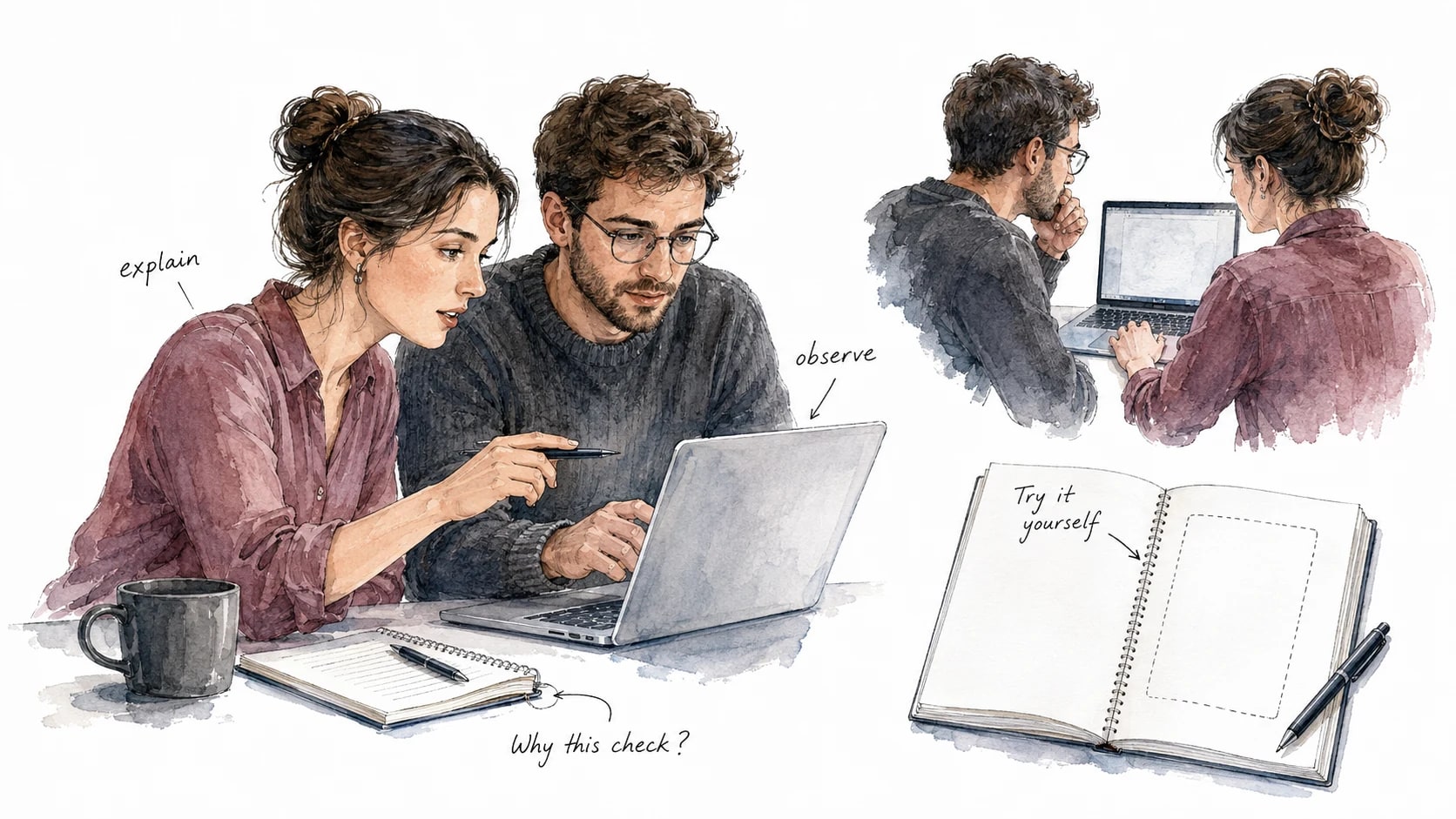
Teach to clarify; observe to expand. Explaining a workflow asks you to put its decisions into words. Watching another person work can suggest decisions or experiments you had not considered. Both can complement solo practice, especially when the exchange includes actual inputs, mistakes, and checks rather than a polished demonstration alone.
They teach because explaining forces clarity
When you explain an AI workflow to someone else, vague intuition has to become explicit. You have to name the task, the setup, the prompt, the model choice, the quality check, the failure modes, and the judgment call. The act of teaching exposes gaps you did not notice while working alone.
You may know when a workflow's result feels wrong before knowing how to explain why. Teaching gives you a reason to examine that judgment. If a learner asks why you kept a condition in a meeting summary, compare the wording with your intent: you wanted to report what was agreed, and the condition shows that hosting still depends on room availability. This is : examining your own understanding and judgment. Expressing that awareness in a checkable instruction helps another person or an AI apply the judgment on a later task.
For a small teaching exercise, use a hypothetical note: 'If the room is available, I can host the workshop on Thursday.' Ask the learner to request an AI summary, then compare the summary with the note. If it says the workshop is confirmed, ask which words support that claim. Explain the conditional offer, have the learner add a check for conditions to the prompt, and try a different note. Check whether they can explain the distinction and whether the revised prompt preserves it.
They observe how other power users make and check decisions
Power users seek proximity to other power users. They join communities, compare workflows, watch screen shares, trade prompt libraries, and ask better questions than 'what prompt did you use?'
Better questions: 'What did you try before this worked?' 'What do you always check before trusting the output?' 'Where does this workflow usually fail, and how did you teach the system to catch it?' 'When the stakes are high, which sources, tests, or qualified reviewers help you decide whether AI can meet the standard?' 'How do you decide when to switch models?' 'What did you stop doing that you used to think was necessary?' 'What is the wildest thing you have tried just to see if it would work?'
These questions can reveal decisions omitted from a saved prompt: why someone checked an uncertain claim, which input justified a recommendation, or what made them change models. Ask them to explain the reason while the example is visible. The explanation may belong in a saved prompt or tutorial after all; observing the work helps you discover what was missing.
An observed habit is useful when its reason transfers
A colleague might revise every answer three times. Ask what each revision is meant to improve, then examine a case where the earlier draft already met the standard. Did the extra revision correct a remaining problem, reveal a useful alternative, or add no value? The reason for continuing gives you something to test on your task; the number of revisions alone does not.
A surprising habit suggests a question: does that approach help on your task? A learner's question may reveal a gap in your explanation, or simply a different goal. Give AI permitted notes from the exchange and ask it to distinguish what you observed from what it infers. It can then propose a small comparison, such as trying two ways to supply context on the same input and checking which preserves the relevant details.
They keep discovering new workflows after solo practice slows down
New discoveries may become less frequent when you keep repeating the same tasks with the same prompts and examples. Teaching, observing peers, or trying an unfamiliar project can introduce variation. There is no fixed number of months at which this happens. Look at what your practice contains and what it is helping you learn.
A conversation with another power user can expose a workflow pattern you would never have invented alone. A teaching session can reveal that a step you thought was essential is unnecessary. A community thread can alert you to a model update that changes the reliability of a task you depend on.
Experimentation, teaching, and community can feed each other. Play suggests a new project; explaining it reveals a missing instruction; watching a peer suggests another way to check the result. Strategy helps you choose which possibility serves your goals, and routines make room to try it. When an improvement works and will recur, ask AI to help encode it in a prompt, standard, or workflow. Delegate through those saved instructions while continuing to test and expand what the workflow can do.
Learn by teaching a useful workflow and observing experienced work
Extract learning from teaching a workflow and observing a power user
Claude compares your teaching and observation notes, identifies questions to test, and proposes a workflow change. You supply the raw notes.
- Copy the promptUse the copy button above the box.
- Paste it in Claude or CodexMake sure your active project is enabled.
- Answer the questionsGive clear answers so it understands what you want made.
- Test it to see if it worksTry the output and refine until it does what you need.
Problem: Teaching and observation can reveal decisions that my usual workflow leaves implicit.
Intent: I want to use those encounters to improve my understanding and test a useful change in how I work with AI.
Ask for notes from teaching a workflow and from observing someone else use AI. Do not assume I have completed both activities. If an activity has not happened, help me plan what to demonstrate or observe; analyze only the evidence I can supply.
For a teaching session, ask what I demonstrated, what the learner tried, which questions they asked, and what was difficult to explain. Request the input, prompt, result, or correction when needed to understand a difficulty. A learner's question may reflect missing instructions, a different goal, or a gap in my understanding; distinguish these possibilities.
For an observation, ask what I saw the person do, what reason they gave, what they checked, and what surprised me. Separate their explanation, my observation, and your inference. Do not invent the person's habits or the benefit of a technique.
1. Summarize the decisions the notes help explain and the questions they leave open. Do not require a weakness when the evidence shows none.
2. For a consequential unanswered question, suggest how to investigate it through a source check, a question to the person, or a comparison on a representative task. Describe the input and result to examine, and allow an inconclusive outcome.
3. Propose a workflow change only when my notes support a useful test. Explain what could improve, what could go wrong, and what evidence would justify keeping it.
4. Draft a concise playbook for the workflow I taught, if I supplied enough detail. Include established steps and checks, and separate proposed repairs or unresolved questions from instructions ready for another person to try.
Scope: reflect and plan only. Do not run experiments, contact anyone, or save personal instructions. Ground any account of my preferences or habits in my actual notes and ask me to confirm it before any later saving.
References
1 source- 1Expecting to teach enhances learning and organization of knowledge in free recall of text passagesView source
John F. Nestojko, Dung C. Bui, Nate Kornell, Elizabeth Ligon Bjork · 2014 · Memory & Cognition
Participants studied a passage expecting either to teach it or to take a test. Those expecting to teach produced more complete, better organized free recall in the first experiment and answered more questions about main points correctly in the second. No participant taught before testing.
Preparing to explain can encourage a learner to organize material around what another person will need to understand. Try that preparation on a workflow, then check whether the explanation helps someone use it.
This study tested text learning under laboratory conditions, not AI workflows or the speed of professional skill development. It does not establish that teaching always beats solo practice.