Separate the questions you need to check in a complex deliverable. A quarterly sales summary needs accurate figures, a defensible interpretation, and an explanation the leadership team can use. A polished page can succeed at the last of these while failing at the others. Distinguishing the concerns helps you inspect what matters before accepting the summary.
Becoming an AI Power User
Becoming an AI Power User
220 min leftPage 103 of 223 (est.)
3.1Decomposition and Parallel Work
They separate complex tasks into data, reasoning, and presentation so each part can be checked
Developing
Ask what the task needs to know, what it should conclude from that information, and how the conclusion should be explained. Call those concerns data, reasoning (also called the logic layer), and presentation. They need to agree, but they can have different checks. A source comparison checks a figure; a calculation checks a percentage; an audience review checks whether the explanation is clear.
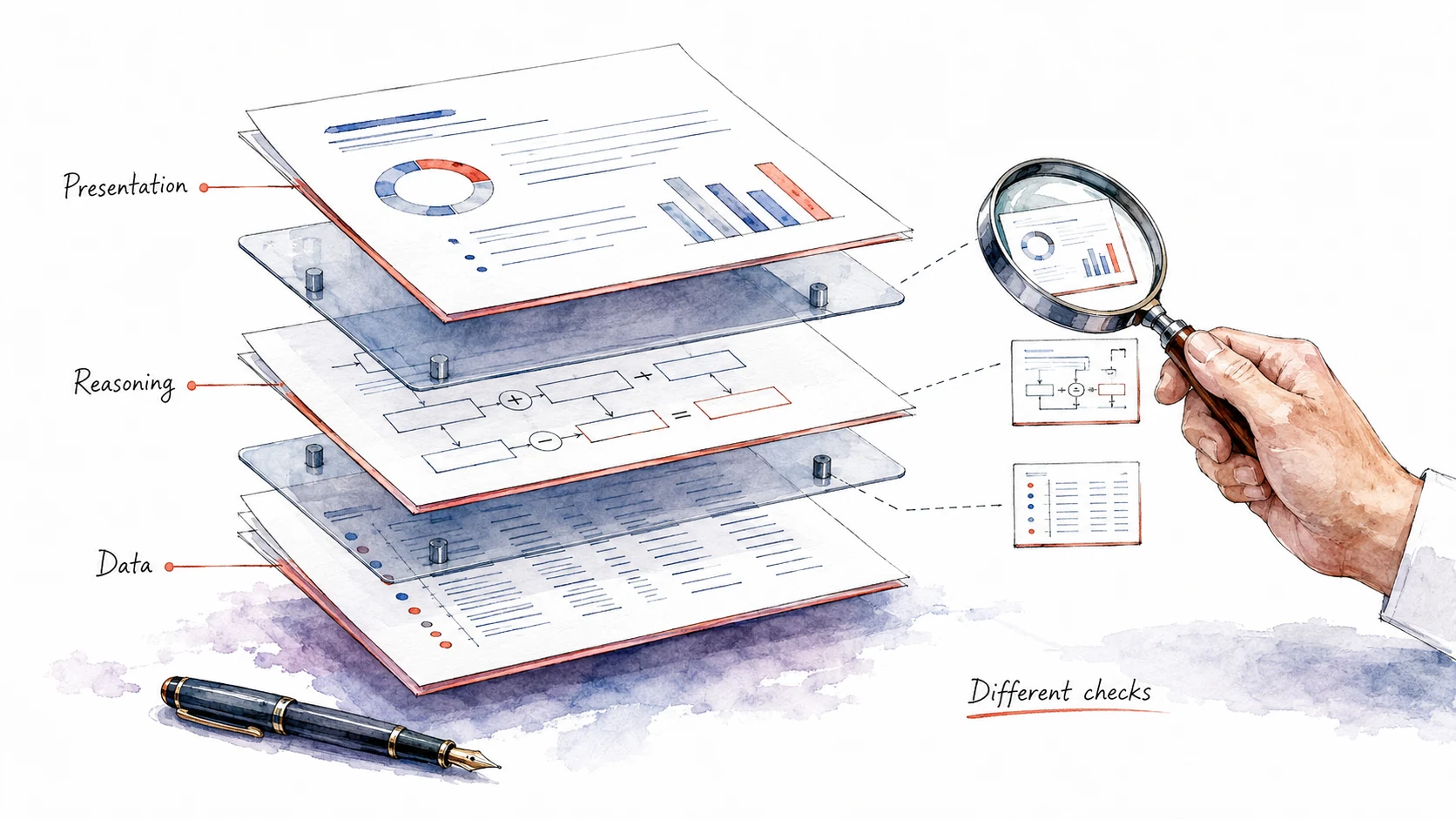
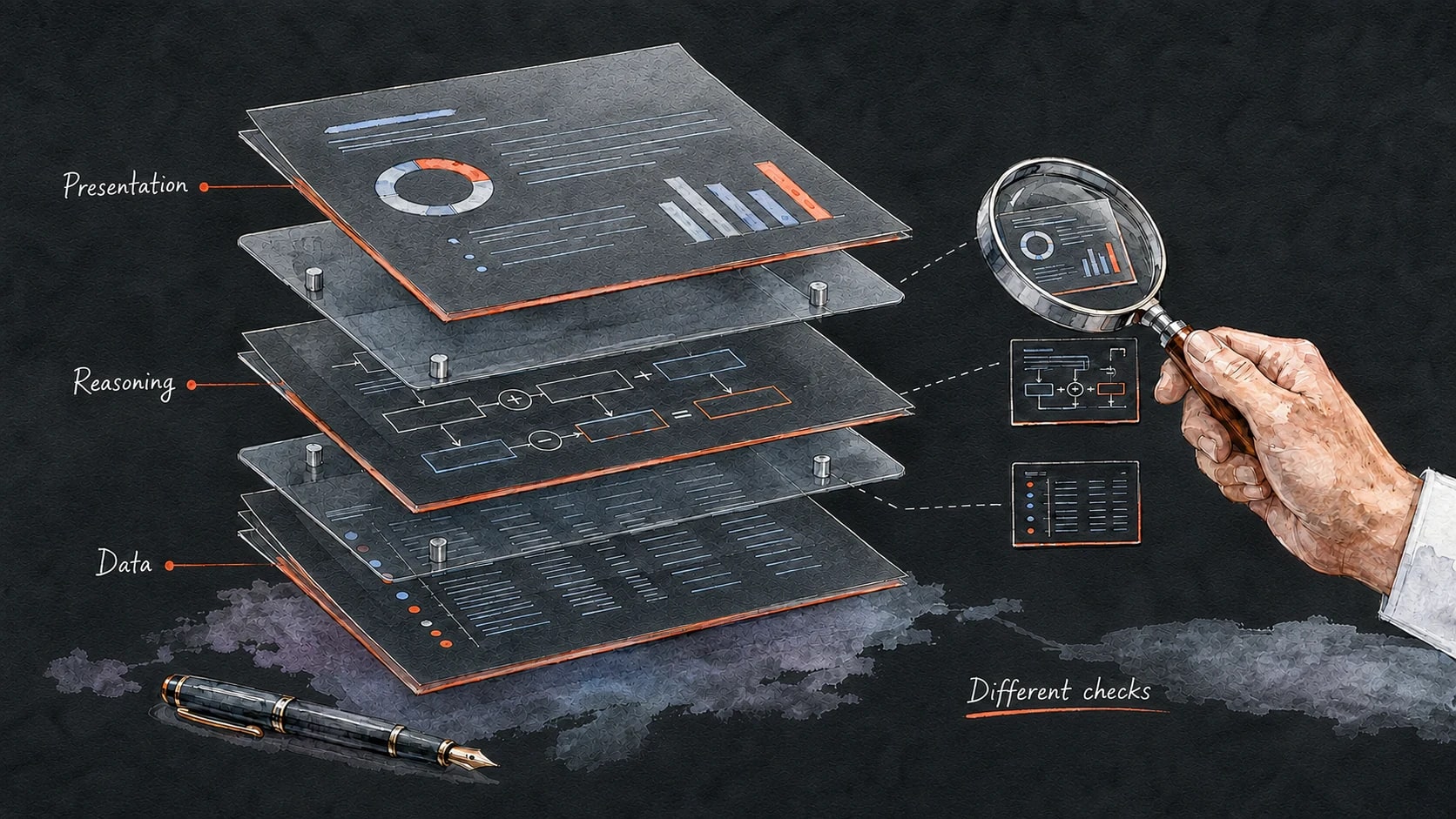
Separation helps you locate and repair errors. If a sales summary says revenue grew by 20%, inspect the source figures and calculation before deciding how to explain the growth. A polished sentence and a rough note both need checking; the separate stages give the check a defined place in the workflow.
Specify the sources and facts the task needs
The data layer names the material the task will use. It can include documents, figures, observations, examples, and context about the audience. Label sources so the assistant and any reviewer can distinguish what the records establish from what the instructions ask them to do.
Specify where the facts come from. Ask which source is authoritative, which period the figures cover, and what exclusions matter. The assistant can retrieve connected records, read an attachment, or use material in the conversation. Separate labels or sections may be sufficient; a second message is not required to make the distinction.
Consider an illustrative sales report. The source table says: 'Q1: $100,000 recurring revenue, no one-time revenue. Q2: $90,000 recurring revenue plus a $30,000 one-time order.' Add the purpose: 'Help the leadership team understand whether the increase is likely to recur.' The source figures and the question have different roles. The assistant needs both before it can produce a useful analysis.
Provide the data as a clearly labeled block, attach a file, or connect the source the assistant should read. Preserve enough detail to check a disputed claim. A source name and location beside each extracted figure help a reviewer trace it back without searching the entire conversation.
Check the reasoning before writing the final explanation
The reasoning layer states the conclusions and what supports them. The presentation layer explains those conclusions for a reader. Ask the assistant for both at once when that works, or require a separate analysis when the conclusion needs checking before it is drafted.
For the illustrative sales report, ask the assistant to calculate the total change and separate recurring from one-time revenue. The analysis should show: 'Total revenue increased from $100,000 to $120,000, a 20% rise. Recurring revenue fell from $100,000 to $90,000, a 10% decline. The $30,000 one-time order accounts for the difference.' Have a calculation tool verify the arithmetic, then compare the figures with the source table.
The final summary could say: 'Total revenue rose 20%, supported by a $30,000 one-time order. Recurring revenue fell 10%, so the increase does not establish stronger repeat business.' The explanation preserves a distinction the headline figure alone would hide. If the draft instead says 'Demand is growing strongly,' ask for the evidence behind that additional claim.
Read the layers to find where an AI output went wrong
Use the three concerns to investigate a flawed result. Is a figure wrong or missing? Does the analysis support the conclusion? Does the wording preserve that conclusion? Separating these questions helps you decide which evidence to inspect.
Repair the concern that failed. A missing sales period needs a source correction. An incorrect growth rate needs a calculation check. A sound calculation presented as evidence of future demand needs a narrower claim. Check any downstream sentences affected by the repair.
Ask the assistant to diagnose an error from the intermediate results. Give it the source inventory, analysis, final draft, and criteria. Ask it to identify where the available evidence locates the error, distinguish possible causes from established ones, and state what remains unknown. If the failure is likely to recur, ask it to propose a check. Test the check on a known failure and a correct example before adding it to the recurring workflow.
Define the checks alongside the production steps. For the sales summary, the figures must match the source, the percentages must calculate correctly, and the prose must distinguish one-time from recurring revenue. Those criteria can guide the assistant while it works and a reviewer afterward. A separate review pass is useful when it adds evidence or catches failures the production pass missed.
Split a task apart before you run its parts in parallel
Task boundaries guide conversation assignments and review. Knowing which work requires different inputs or checks helps determine what belongs in a separate context. An editor needs the draft and relevant criteria; a researcher needs the question and sources. Preserve the dependencies when coordinating their results.
Separation does not make dependent stages parallel. Data collection must finish before analysis that uses it, and a final explanation needs the settled analysis. Independent source searches or checks can run concurrently. Give the assistant the dependencies so it can choose what to run together and what must wait.
Save a tested sequence for a recurring task. Keep the source instructions, analysis requirements, presentation rules, and checks together. Ask the assistant to run the sequence on the next input and report any failed check. As the sequence proves useful, delegate more of its coordination while retaining evidence that each run meets the requirements.
Split one complex task into three layers
Split a complex task into data, logic, and presentation
Open a conversation in Claude with a recurring task and your usual prompt. Ask for a staged sequence and a comparison plan, then test whether the added checks justify the handoffs.
- Copy the promptUse the copy button above the box.
- Paste it in Claude or CodexMake sure your active project is enabled.
- Answer the questionsGive clear answers so it understands what you want made.
- Test it to see if it worksTry the output and refine until it does what you need.
Problem: A complex AI task can fail in its sources, reasoning, or presentation, and I want to check those concerns separately.
Intent: I want to design a staged prompt sequence for a recurring task and compare it with an all-in-one request.
Ask me for the task, my usual prompt if I have one, the intended audience, and the sources or examples the task uses. Ask focused follow-up questions only when missing information would change the sequence or its checks. Use my supplied material; distinguish confirmed facts, assumptions, and information still needed.
Once you have enough context:
1. Describe the DATA LAYER: the sources, figures, constraints, audience context, and examples needed for this task. State how to check extracted facts against their sources and what to do when required information is missing.
2. Describe the REASONING LAYER, also called the logic layer: the calculations, comparisons, judgments, and questions the analysis must address. State what evidence would support the conclusions.
3. Describe the PRESENTATION LAYER: the audience, required sections, format, tone, and length. Explain which qualifications and distinctions the final wording must preserve.
4. Draft a prompt for each layer, in dependency order. Each prompt must state its inputs, required output, and checks. Have later prompts request the preceding result if it is missing. Keep source references and unresolved questions in the handoffs. Explain when I should inspect an intermediate result and when the assistant can perform the check as part of the sequence.
5. Identify what the separate stages let me inspect that my usual request leaves hard to check. If one request can perform the same checks reliably, include that option.
6. Give me a comparison plan using the same source material, goal, and criteria for the staged sequence and the all-in-one request. If I have no usual prompt, draft an all-in-one baseline from the same brief. Compare accuracy, reasoning, clarity, and total effort, including setup, review, and handoffs.
Return the prompts and comparison plan here. Do not run the task or draft its final deliverable. After I provide trial results, help me decide what to reuse; ask for confirmation before saving any reusable personal workflow.