Becoming an AI Power User
Becoming an AI Power User
170 min leftPage 130 of 223 (est.)
4.3Calibration and Evaluation
They verify AI claims against sources because confident wording does not establish accuracy
Developing

Check the evidence behind confident wording
An assistant can state a supported finding and an unsupported inference in equally polished language. It can also express uncertainty or identify missing evidence. The wording alone does not establish accuracy. Ask what evidence supports the claim and whether the inference follows from it.
Suppose you are recommending a working arrangement for your team. You ask for research on remote-work productivity, and the brief says, 'Remote work raises productivity across knowledge work.' That wording hides several different questions: fully remote or hybrid work, which jobs, and productivity measured how? A useful research brief preserves those distinctions.
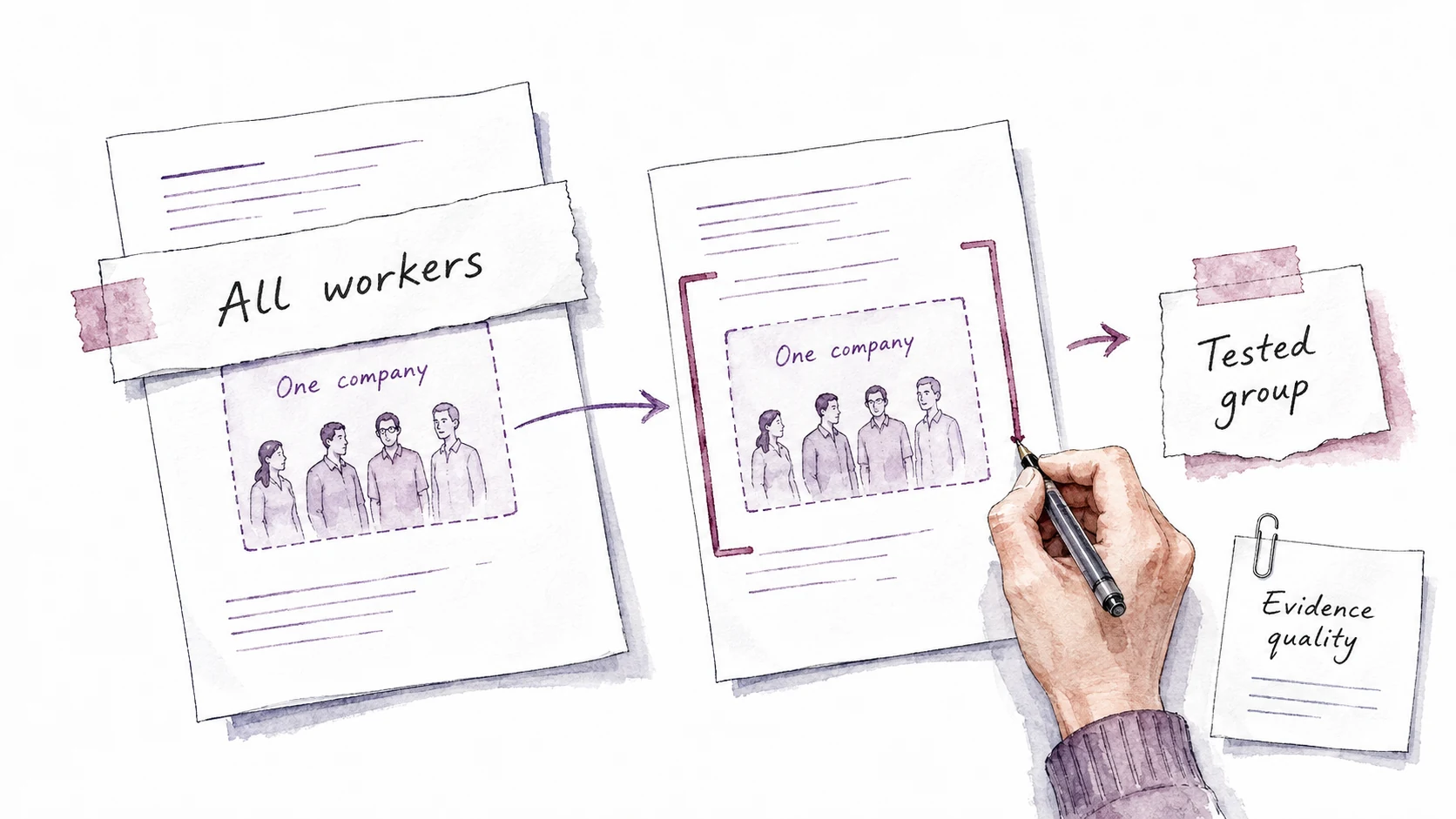
Compare the breadth of the claim with the breadth of the evidence. A study about employees at one firm may inform your decision without establishing a rule for every workplace. If the assistant broadens a local finding into a universal claim, revise the claim and explain what would have to be similar for the finding to apply to your team.
A source can exist and still fail to support the conclusion attached to it. The paper might study a different outcome, a different population, or a different working arrangement. Checking these details helps you decide what the finding can reasonably contribute to your recommendation.
Source-grounded research includes a separate claim check
Research tools can search the web, retrieve documents, and assemble cited reports. Use those capabilities to gather evidence and draft a synthesis, then check the consequential claims. A citation is a reference to inspect. Its presence alone does not establish that the assistant read the source correctly.
Prepare a checkable question, gather suitable evidence, and compare the resulting claims with that evidence. The remote-work example shows how each step affects the conclusions the evidence supports.
Ask a question the available evidence can answer
Specify the decision, population, arrangement, and outcome you care about. For the team recommendation, try: 'What controlled studies compare two days of home working with full-time office work for employees doing similar jobs to ours? Separate performance, retention, and job satisfaction.' Set a date range when the decision depends on a particular period. Ask the assistant to include relevant conflicting findings and distinguish direct results, inference, and unsupported assertions. A broad exploratory question can help you discover what to ask next; a decision needs a more precise claim.
Test the answer against the claims that would change your decision
Check that the source exists, supports the assertion, and fits the decision. Evidence quality depends on the question. A randomized study can help estimate an intervention's effect, while current official documentation is often the direct source for a product feature. Assess methods, population, outcome, recency where relevant, conflicts of interest, and agreement with other evidence. Peer review and institutional reputation are useful context, not automatic grades.
For a consequential report, it can help to gather a source set before asking for a synthesis. Require citations to that set and mark any broader interpretation explicitly. This gives a reviewer a defined body of evidence to inspect. It does not prevent every unsupported inference, and the source collection itself may omit relevant or conflicting findings.
A research synthesis should preserve the connection between each finding and the evidence that supports it. It should also identify what the writer inferred from those findings.
Open the cited source for every decision-shaping claim before you trust the brief
A cited brief is ready for inspection when its claims link back to specific passages. You may find a supported conclusion, a narrower finding, a contradiction, or no evidence for the assertion. Record which one occurred.
The remote-work example exposes a mismatch between claim and evidence. In a randomized Trip.com study conducted in 2021–2022 and published in 2024, 1,612 employees were assigned either two days of home working a week or full-time office work. Researchers found lower attrition and no detected effect on performance reviews. A brief saying 'Remote work raises productivity for all knowledge workers' would change both the outcome and the scope. A defensible summary says that this hybrid arrangement reduced departures without a detected performance-review penalty in the studied company.
Verification compares the assertion with the source. An assistant can find the relevant passage, quote a short supporting excerpt, and flag differences in population, outcome, or scope. Give the reviewer access to the original and record where the passage appears. Review important claims even when the assistant marks them supported; its self-assessment is another claim to check.
Source tracing answers whether a citation supports a claim. A related practice, , answers who is behind a source and how other credible sources assess it. Both can matter before you rely on a research brief.
Wineburg and McGrew studied how professional fact-checkers, historians, and students evaluated online information. The fact-checkers frequently left the original site to investigate it elsewhere. For AI-assisted research, delegation of that investigation should include a requirement for links to the evidence. If several pages repeat the same report, trace them back before treating them as independent support.
Record what each consequential claim is supported by
A gives the verification a record another person or assistant can inspect. For each consequential assertion, record the source passage, whether it supports the assertion, and any limits. An empty evidence field shows unfinished work. A completed row is useful only when its contents came from checking the source; filling a table cannot guarantee that the check happened.
Put the research question and the decision it informs above the ledger. Then give each consequential claim its own row, preserving the brief's exact wording and cited source. Keep citation support separate from evidence quality. A weak study may be summarized accurately, while a strong study may be cited for a conclusion it never tested. Record both judgments before deciding how to use the claim.
The row should let another reviewer reproduce the comparison. In the remote-work example, the notes identify the hybrid schedule, performance-review measure, and studied employees. Those details explain why 'reduced departures without a detected performance penalty in this trial' is supported while a universal productivity claim is not.
Save the verification procedure when the same kind of research recurs. Ask an assistant to extract claims, locate supporting passages, compare scope, and leave unresolved cases for further investigation. Test its comparisons against cases you have already checked. A reusable can carry the lesson to later briefs while keeping the source evidence visible.
Prioritize claims whose failure would change the decision or harm someone relying on it. Background details may warrant spot checks; remove unnecessary assertions you cannot support. Embarrassment is an imperfect guide: a quiet error in a budget or eligibility rule can matter even when nobody sees the author make it.
Produce your first verified research brief
Produce a source-grounded research brief with a claim ledger
Claude synthesizes research with citations and flags inference. You verify the top claims against the original sources and grade the evidence.
- Copy the promptUse the copy button above the box.
- Paste it in Claude or CodexMake sure your active project is enabled.
- Answer the questionsGive clear answers so it understands what you want made.
- Test it to see if it worksTry the output and refine until it does what you need.
Problem: I need to know which findings can support a decision and which remain uncertain.
Intent: I want a source-grounded research brief with a claim ledger I can use to check consequential assertions.
Ask what question I want to investigate and what decision the answer will inform. Help me specify the relevant population, comparison, outcome, and time period where those apply. Use my answers; do not invent facts about my team or my priorities.
Ask me to paste or attach sources I already have, or identify sources accessible through the available research tools. If you cannot reach the material needed to answer the question, ask what I can provide and explain the remaining limit.
Please:
1. Produce a brief detailed enough to answer the question. Cite each factual claim with an identifiable source: author or organization, title, date, and URL or document location.
2. Distinguish direct findings, your inferences or extrapolations, and assertions for which evidence is missing. Preserve the population, comparison, outcome, and conditions each finding concerns.
3. Include relevant conflicting findings and explain what differs between the studies or sources. Leave disagreements unresolved where the evidence does not resolve them.
4. Put the research question and intended decision above a claim ledger. Include every assertion whose failure could change the decision or harm someone relying on it. Use these columns: Claim, Source Cited, Evidence Quality, Verification Status, Supporting Passage and Location, Limitations, and Action.
5. For each consequential claim, provide a short excerpt or precise paraphrase, with the page or section and source link. Propose a citation-support status: confirmed, partly supported, unsupported, or contradicted. Mark any check you could not complete as pending and identify what is missing. Keep your proposed status distinguishable from a check I have completed.
6. Assess evidence quality as strong, moderate, weak, or uncertain for the particular claim, with a reason based on methods, relevance, limitations, and corroboration. An accurate summary of a weak source can still provide weak evidence. Use current official sources for product facts and suitable research designs for causal claims.
7. End with the consequences for my decision: what the evidence supports, what needs narrower wording, and which uncertainties need further investigation. Prioritize missing, conflicting, or indirect evidence behind consequential claims. Explain what I should inspect in the original sources to check your assessments.
After I provide my source checks, update the affected claims and ledger entries to reflect what was checked and what remains pending.
Do not invent citations, URLs, source titles, findings, or completed checks. State access limits directly. A claim you mark supported still needs verification appropriate to its consequences.
References
3 sources- 1
Mark Steyvers, Heliodoro Tejeda, Aakriti Kumar, Catarina Belem, Sheer Karny, Xinyue Hu, Lukas W. Mayer, Padhraic Smyth · 2025 · Nature Machine Intelligence
In question-answering experiments, participants tended to overestimate accuracy from default explanations. Longer explanations increased confidence without improving their ability to distinguish correct from incorrect answers.
Presentation can influence trust separately from correctness; check the evidence a decision depends on.
The experiments used GPT-3.5, PaLM2, and GPT-4o on multiple-choice and short-answer questions. They do not establish the calibration of current models or every kind of research report.
- 2
Nicholas Bloom, Ruobing Han, James Liang · 2024 · Nature
The randomized Trip.com experiment studied a hybrid schedule. The treatment group had lower attrition, and the researchers found no effect on performance reviews.
Separate the measured outcome and studied arrangement before using a finding in a recommendation.
The result concerns employees at one Chinese technology company under a particular hybrid policy. It is not a universal claim about fully remote work or all knowledge workers.
- 3Lateral Reading and the Nature of Expertise: Reading Less and Learning More When Evaluating Digital InformationView source
Sam Wineburg, Sarah McGrew · 2019 · Teachers College Record
In a study of 45 participants evaluating websites, professional fact-checkers used outside sources to investigate credibility and reached more warranted conclusions than the other groups.
A source's appearance and self-description are insufficient grounds for judging its credibility.
This study investigated website evaluation, not AI research systems. Applying the strategy to AI-assisted research is an editorial transfer of the practice.