Becoming an AI Power User
Becoming an AI Power User
274 min leftPage 73 of 223 (est.)
2.1Working With the Model
They brief AI like a collaborator because search-engine defaults quietly hold the work back
Developing

An old habit can persist after the task has changed
A familiar method can become your default even when another method would fit better. You may type a few keywords because that has worked for years, because you are in a hurry, or because you expect the assistant to ask follow-up questions. The useful question is whether this request gives the assistant enough to proceed. The origin of the habit is a separate question.
Use your recent chats as evidence. Give the assistant the exchanges you want reviewed, or point it to chat history it can access. Ask it to quote the request and response that reveal an ambiguity or omission, explain what information was needed, and suggest a correction. It should report when the exchange does not support a finding. An ambiguous instruction has wording to quote; missing information has to be identified from what the task required.
A task-specific brief supports a task-specific answer
A request for general advice gives the assistant room to answer generally. A request about a particular situation needs the details that distinguish it. Supply the facts that would change the answer. Those can arrive in your prompt, a document, a connected source, or a conversation the assistant can already access.
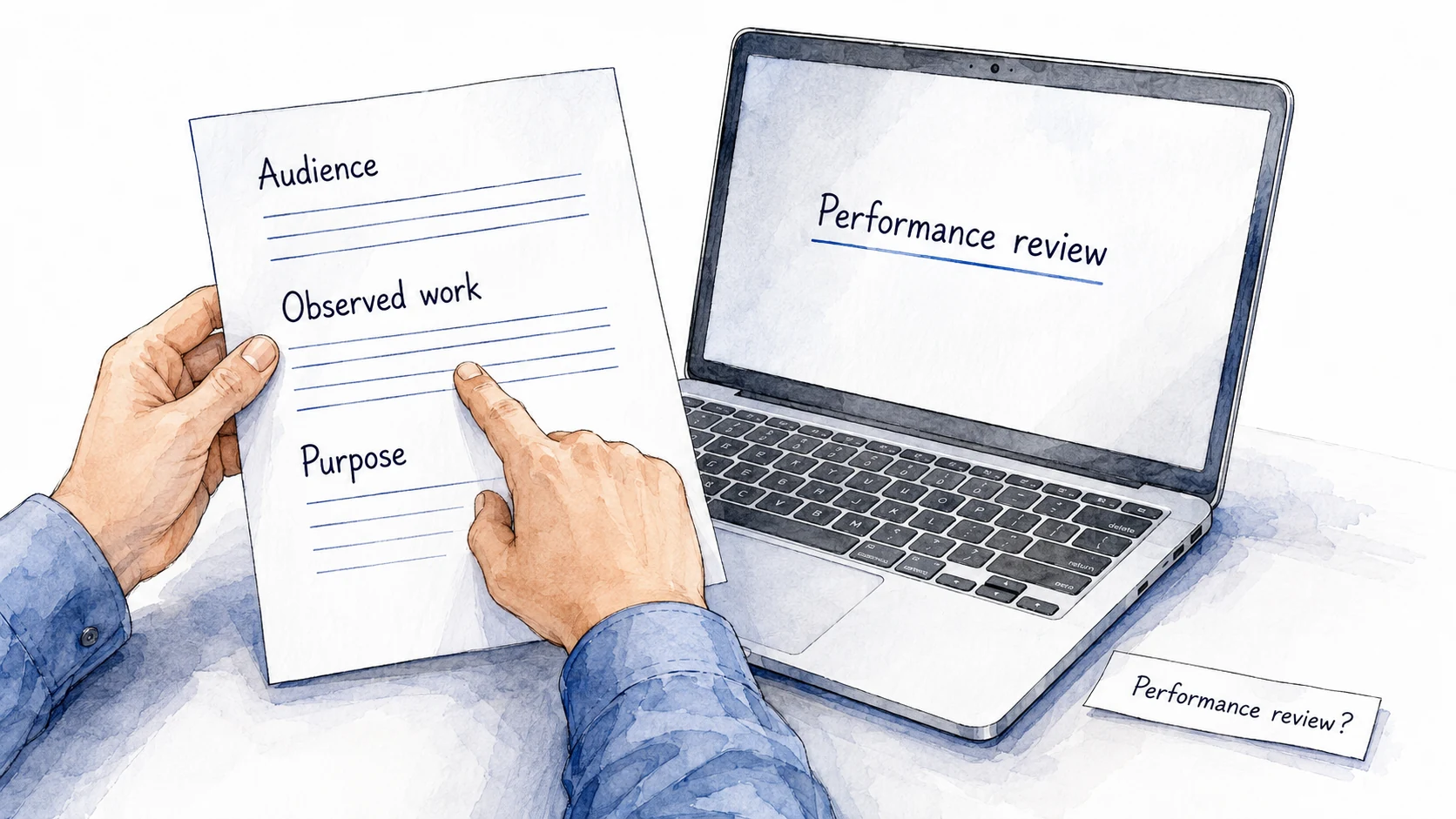
Suppose you type 'tips for a performance review.' A plausible reply is 'Recognize strengths and offer constructive feedback.' Now give it a particular case: 'Robin found the release bug before launch. In planning meetings she often sends her concerns afterward. Write brief feedback that recognizes her contribution and invites earlier input, without treating quietness as a flaw.' A possible draft is: 'Your testing caught the release bug before customers encountered it. I would like us to make room for your concerns earlier in planning, whether you raise them in the meeting or send notes beforehand.' The brief supplied the observation and the goal; the draft can now be checked against both.
Choose by the evidence the task requires. For a factual lookup, use a tool that retrieves an authoritative source and lets you inspect it. That may be a search engine or an AI assistant with search. For a review, proposal, or analysis, give the assistant both the source material and the purpose. Retrieval and drafting can belong in the same workflow.
A weak first answer can reveal a useful next step
A weak first answer is evidence to investigate. The assistant may be missing context, following an ambiguous instruction, using an unsuitable tool, or failing at the task itself. Ask what would resolve the specific defect before deciding whether to make another attempt.
In Microsoft and LinkedIn's 2024 Work Trend Index (opens in a new tab), the survey-defined power users were 30% more likely than other respondents to report persisting after an imperfect first response. This is a self-reported association, not evidence that persistence alone produces expertise or that every task improves with more turns.
Suppose the performance-review draft says 'Be more proactive.' You could replace the line yourself, or ask: 'Use the meeting example I supplied. Suggest a way to raise concerns earlier without criticizing Robin's quietness.' The follow-up gives the assistant a specific repair. Check whether the new wording does it.
Separate stages when an intermediate result needs checking
A complex request can hide a dependency that deserves its own check. If a recommendation depends on a comparison, and the comparison depends on source facts, an error in the facts can spread through the finished answer. An assistant may handle the entire sequence from one request; staged work is useful when you need to inspect or correct an intermediate result.
A long conversation can also contain instructions for several unfinished jobs. If research notes, rejected drafts, and new requirements make the current assignment hard to identify, ask the assistant to summarize the active goal, settled facts, and outstanding questions. Check that summary before continuing or using it to start a separate conversation. Separating work helps when each conversation can receive the context its assignment needs.
For example: 'Compare the three suppliers in these quotes against cost and delivery date, then recommend one.' If the quotes have complicated exclusions, first ask the assistant to extract each price, delivery date, and exclusion with a source reference. Check that table before asking for the recommendation. If it can produce and verify both stages reliably in one run, the sequence is a candidate for delegation as a whole.
Preserve the method you want to use again
A useful conversation can remain in chat history while its useful instructions are hard to recover. Preserve the instructions, examples, and checks that you expect to reuse. A named prompt or skill is easier to invoke on the next performance review than a long conversation containing several rejected drafts.
Save a method when you expect to use it again. After a useful review, ask the assistant to extract the instructions and checks that helped, remove details specific to this teammate, and propose a reusable prompt. Check that it preserves your intent before saving. For recurring work, use /skill-creator to save an initial skill from the requirements you know. Update its instructions as you develop improvements and standards, then test the revised behavior on relevant examples.
Assuming AI cannot do something locks in a stale test
One unsuccessful attempt tells you about a particular task, model, and setup. A later model, a better source, or a different tool may change the result. Keep a useful failed task as a test case. When something relevant changes, rerun it against the same success criteria before deciding whether it belongs in your workflow.
Revisit a failed task when a relevant part of the setup changes. Ask the assistant to preserve the input, the failure, and the criteria for success. A later test can compare a new model or tool with that same case. Add the task to a reusable workflow only after the evidence supports relying on it.
Repeated failures suggest which instruction to revise
Start with a habit whose repeated cost is visible in your work. If the assistant invents context, check whether the relevant source was available and whether the answer used it correctly. If a useful draft keeps arriving only after the same correction, save that correction in the instructions. Choose the intervention from the failure you observed. The five categories help you look; they do not establish a universal ranking.
Why might a useful habit still go untried? In Paradox of the Active User (opens in a new tab), John Carroll and Mary Beth Rosson describe a tension between completing the current task and learning a better way to use an application. Their 1987 account concerns people learning computer applications. The same tension is a useful lens for an AI workflow, without proving why any particular person delays an experiment.
Keep the experiment close to the task that exposed the problem. Ask the assistant to compare your original instructions with the corrected draft and propose a reusable change that addresses the demonstrated gap. Review its proposal against what happened, then try it on another case. That gives you evidence about the change while doing work you already need to finish.
Match the request to the task and the available tools. A source lookup needs retrievable evidence; a calculation needs a reliable calculation method; a draft needs relevant facts and an audience. The assistant can often choose and use those tools for you when its instructions and access are sufficient. Save the current instructions for recurring work in a skill. Add improvements, requirements, and standards as they develop, and test the revised behavior on relevant cases.
Plan a habit change using examples from recent AI chats
Check your AI habits against the five inherited defaults
Claude checks your recent interactions for five possible patterns and proposes corrections supported by your examples.
- Copy the promptUse the copy button above the box.
- Paste it in Claude or CodexMake sure your active project is enabled.
- Answer the questionsGive clear answers so it understands what you want made.
- Test it to see if it worksTry the output and refine until it does what you need.
Problem: I want to understand recurring difficulties in my AI work.
Intent: I want an audit grounded in my recent interactions, with corrections I can test.
Use the interactions I provide or identify for you. If you cannot access them, ask me to paste the exchanges or describe the request, response, corrections, and outcome. Ask what I wanted to accomplish if that is unclear.
Check these possible patterns:
1. Missing context: Did the task require facts, sources, or a goal that the assistant did not receive?
2. One-and-done: Did I leave a weak result unresolved when a specific follow-up might have helped?
3. Prompt overload: Did conflicting instructions or an unchecked dependency cause a problem? A long prompt or several stages in one request is not sufficient evidence.
4. No save habit: Did I rebuild a useful method that I expected to need again? A one-off task may not justify saving anything.
5. Capability blindness: Am I relying on an earlier failed test even though a relevant model, source, or tool has changed? Ask for the earlier test and the change if those are not in the examples.
For each pattern, report strong match, partial match, not a match, or insufficient evidence. Quote the relevant request, response, or correction. Explain the observed cost and distinguish it from your hypothesis about the cause. Do not invent a problem to fill a category; describe a supported problem in its own terms if none fits.
Return a table and prioritize the supported problems by likely benefit and effort to test. For each proposed correction, explain what to change on the next relevant task and what evidence would show whether it helped. If the evidence supports no correction, say so.