Becoming an AI Power User
Becoming an AI Power User
15 min leftPage 215 of 223 (est.)
6.6Workflow Redesign, Creativity, and Growth
They practice regularly and carry tested improvements into later work
Developing

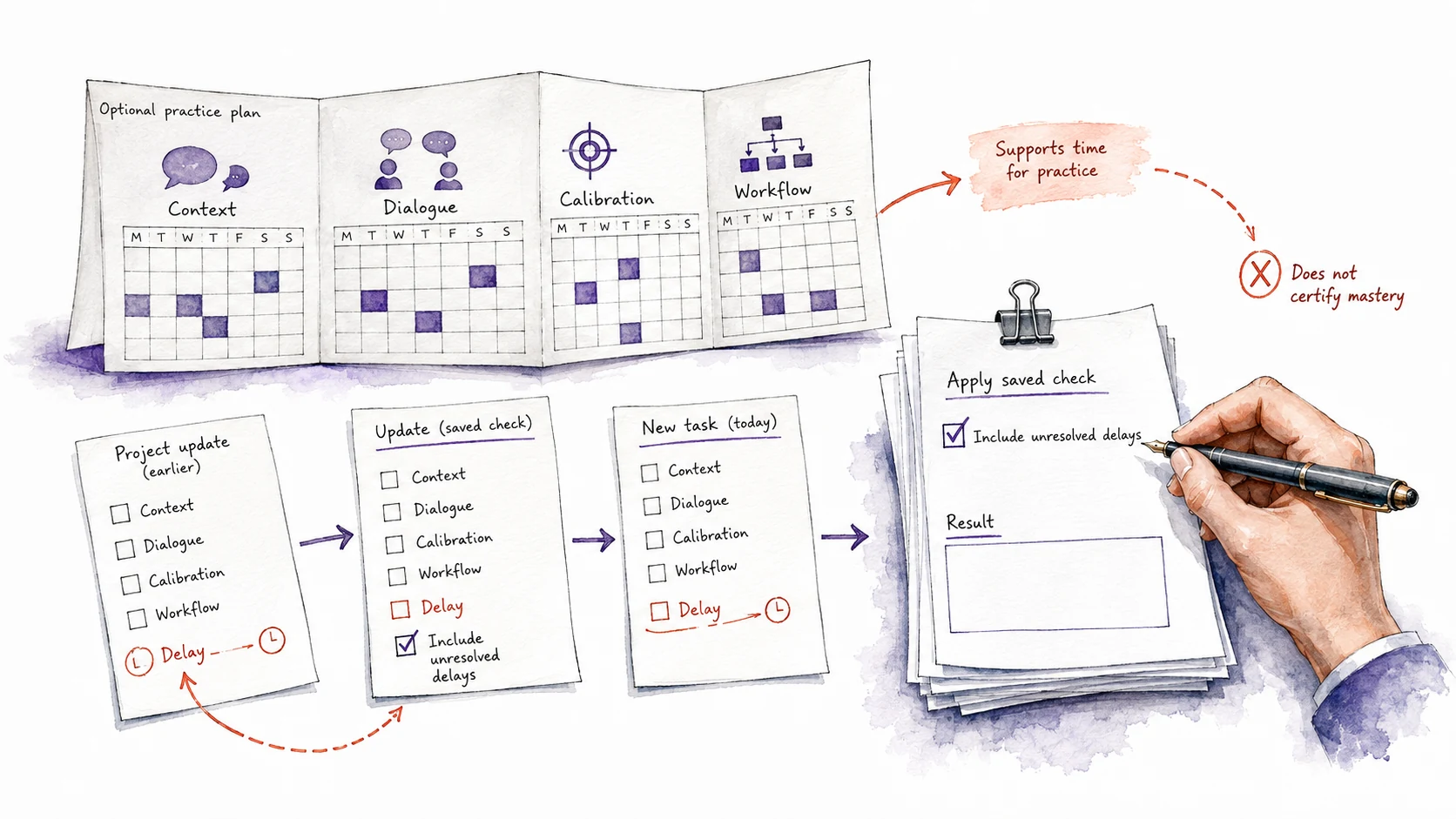
Carry an improvement into the next relevant task. Suppose a project update omitted a delayed delivery. You add the source note and ask AI to check that every unresolved delay appears under open issues. On the next update, reuse that check and see whether it catches a different delay. That is a concrete way for later work to benefit from an earlier correction. A polished prompt or another day of use, by itself, does not show that learning has transferred.
Practice checkpoints determine when to repeat an exercise
The exercises revisit context, dialogue, evaluation, reuse, and exploration in a suggested order. A recurring task can help you compare results across exercises. Choose examples that expose the question you want to investigate, and adjust the scope to leave time for checking what happened.
Each stage asks you to demonstrate something. The context exercises ask whether relevant information changes the result. Dialogue tests the identification and repair of a gap. asks what your tests support. Reuse asks whether a successful approach works on another case. Weeks and weekdays are optional scheduling labels; the checkpoints determine what deserves another attempt.
Week 1: Quality ratcheting, context, and
This first group of exercises helps you compare the result you get with the result you need. Try relevant context, a specific quality check, and a request for AI to improve the instructions. Keep a change when it helps the task, and record an unchanged or worse result just as honestly.
Week 2: Dialogue, , and error-to-
Use dialogue when a question, critique, or alternative could improve the task. A follow-up helps when it clarifies the goal or addresses a specific gap. Try different approaches as exercises; in ordinary work, stop when the result meets the standard or when another approach offers a better prospect.
Week 3: , evaluation, and experimentation
This week, you build judgment about where AI helps and where it breaks in your specific work. Use the tests to record what seems reliable, what remains uncertain, and what to try next.
Week 4: A , workspaces, and redesigned workflows
Save approaches that have worked across representative cases so later tasks can use the established instructions and checks. The first group of exercises focuses on recurring work; the second offers applications involving agents or other people. Choose the exercises that serve your task. A useful shared playbook may need only a tested prompt and example, while a recurring report may benefit from a and workflow map.
Prepare tested instructions for recurring work
Extend a tested approach to agents or shared work
These exercises have different starting points. Agent work needs a task that benefits from file or tool access and clear limits on its actions. Sharing and teaching need a workflow someone else wants to use, with an example and the evidence needed to explain and check it. Start with the application that fits your work.
Check whether the practice transfers to another task
These checks are suggestions for reviewing your practice, not a validated skill scale. Try them on a new example with similar demands. If a result depends on a reminder or a particular prompt, that is useful information about what to reinforce. Ask AI to compare your attempts against these checks and point to the evidence for its assessment.
- You provide context that affects the answer. On a project update, that means the current notes, the audience, and relevant commitments. A self-contained factual question may need no extra brief.
- You revise for a reason. You identify a missing requirement or useful alternative, then check whether a follow-up improved the result. A fixed number of turns is not the goal.
- You investigate failed attempts. Ask AI to compare the result with the request and sources, test a plausible repair, and check whether the problem remains.
- Your confidence has examples behind it. Your records show tasks where a setup performed well, where it failed, and what remains untested.
- You reuse an approach when it fits. A saved prompt or standard helps on a second relevant case. You revise it when the task changes or its checks expose a problem.
- You coordinate parallel work without losing dependencies. Independent steps can proceed together; a step that needs another's result waits for it.
- You judge redesign by the complete result. Compare quality and total effort, including setup, review, and corrections. Keep a redesign when the benefit justifies its cost.
- You learn from other people when the opportunity fits. A colleague can try your playbook, question an assumption, or show an approach to test. Sharing is useful feedback, not a requirement for every private project.
- You keep room for curiosity and play. Try a project because it interests you, alongside the tasks you want to improve. Record a useful discovery when you expect to use it again; you do not need a quota of failures or log entries.
- You delegate through tested instructions. When a recurring approach is reliable, encode its instructions, context, and checks to direct the next run without repeating every step.
Ask what you learned as well as what AI helped you finish
A completed task and an acquired skill are related but distinct outcomes. If AI writes a useful project update, you may still be unable to explain why it included one risk and omitted another. Ask for the reason, compare it with the source notes, and try the same judgment on another example. Improved instructions may support delegating that check once it becomes reliable. Both your understanding and the workflow can improve, but assess them separately.
Choose the next practice task from what you want to accomplish and what your last attempt revealed. An unreliable source check may call for another comparison. A reliable recurring task may be ready for a saved workflow. A playful idea may lead somewhere you could not have planned. Strategy, desire, routines, creativity, and evaluation can contribute together; no calendar or single loop explains all of that progress.
Match the method to the task. A short question may need a short conversation. A recurring client report may justify saved sources, a quality standard, and a review step. As the task or your priorities change, ask AI to help compare those costs and benefits again. Reuse is useful when it serves the result you want.
Revisit the meeting summary with more options
Consider the meeting summary from the opening. A recurring mistake might call for better source context, a clearer instruction, or a more reliable check. If the summary already meets your standard, the useful next question may be what else those notes could help you do.
A reliable list of unresolved decisions could help you prepare a project handoff. Ask the assistant to connect each open question to the task that depends on its answer, then check those connections against the notes. You are testing a more ambitious use of the same material, with a new standard for success.
The opportunity to keep learning comes from that wider range of choices. Developing your own understanding, improving AI judgment, and building workflows around tested instructions and examples offer different opportunities for learning. Verification helps you decide which responsibilities each can handle; play helps you discover what else to attempt.
Aim for trust that fits the task. The evidence may support delegating a recurring report while a new kind of recommendation still needs investigation. Ask AI to help gather and assess that evidence, with checks appropriate to the consequences. When an approach becomes dependable, encode what matters so the next run can start from it and your attention can reach the next question.
The particular models and interfaces will change. Keep practicing how to clarify what you want, test what helps, and use what you learn to attempt more. That includes useful work, playful projects, and problems whose solution would make life better for someone else. I am grateful to the alignment researchers working to make more capable AI beneficial.
References
1 source- 1
Erik Brynjolfsson, Danielle Li, Lindsey Raymond · 2025 · The Quarterly Journal of Economics
The published study examined 5,172 customer-support agents. AI assistance increased issues resolved per hour by 15% on average, with larger benefits for less experienced and lower-skilled workers. The authors also found evidence consistent with worker learning.
Assistance can help people perform a task and may also help them learn from examples of effective work. Check both outcomes in your own practice.
The study concerned an older AI assistant, support tasks, and one company. Its effects are not forecasts for current models, other professions, or this practice sequence. It does not validate a thirty-day path to expertise.