Becoming an AI Power User
Becoming an AI Power User
114 min leftPage 161 of 223 (est.)
5.3Infrastructure and Learning Systems
They keep prompts, specs, and workflows in formats they own, so many capable models can run them
Developing

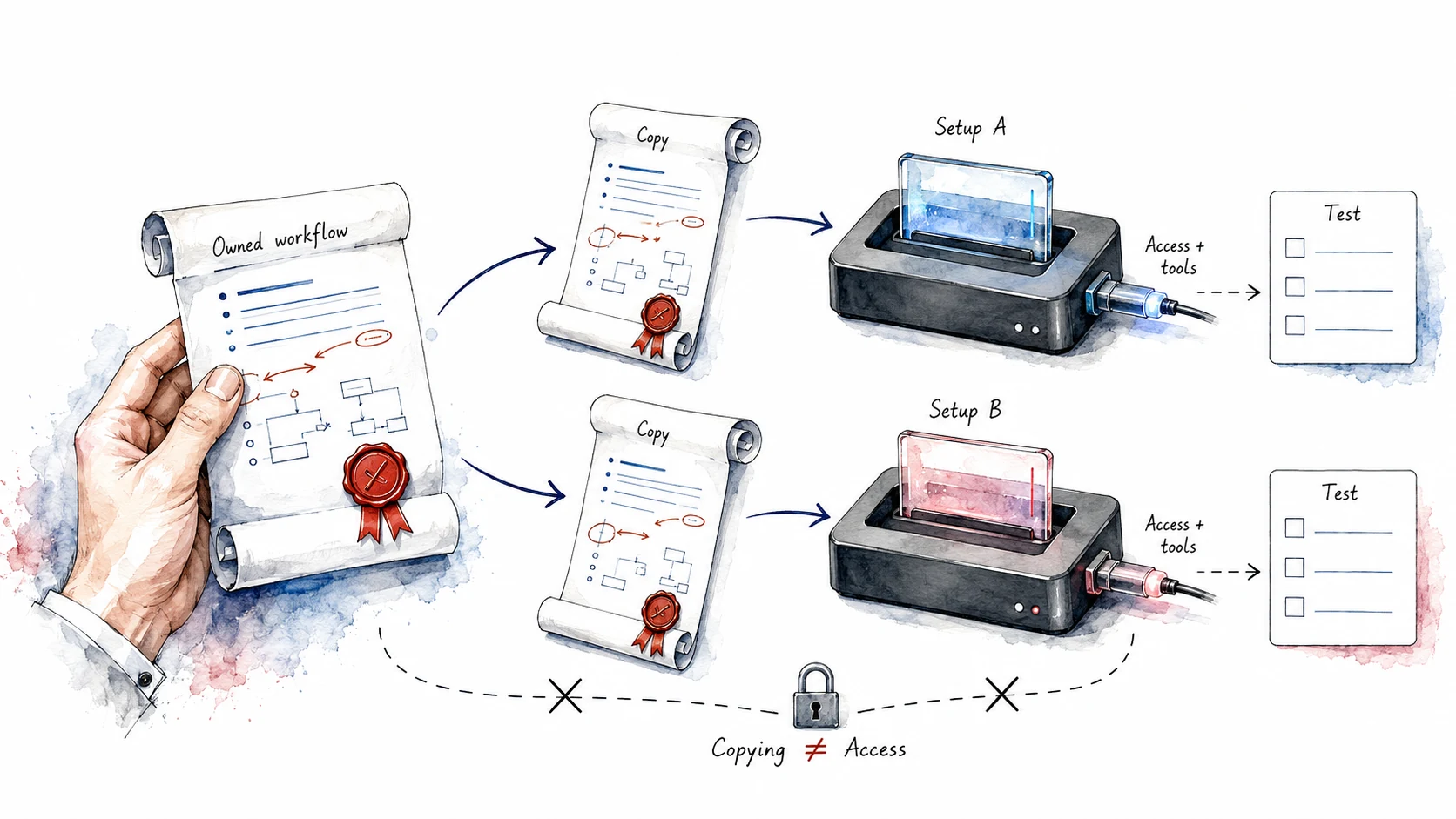
A portable copy preserves your design; a migration test checks whether another setup can execute it. A research prompt may transfer directly. A workflow that depends on a private database or a particular file tool also needs compatible access. Write down those dependencies beside the instructions so switching tools begins with a clear inventory.
Describe the outcome you want, not the tool feature that delivers it
Separate the result you want from the capabilities needed to produce it. A named interface control may change, while a requirement such as citing source passages stays useful. Some features do more than rename an outcome: web access, code execution, and specialized reasoning settings can affect what the tool can accomplish. Keep those requirements explicit instead of assuming different wording can replace them.
Suppose you want a comparison of two long policy documents. A portable request could say: compare the obligations, cite the relevant passages, identify conflicts, and explain the main reasons for your conclusions. This describes an inspectable deliverable. Separately record that the tool must read both documents and handle their length. Asking it to show step-by-step reasoning does not activate a provider's reasoning mode or prove that the explanation reflects every internal step.
Clear requirements and examples are easier to adapt than unexplained prompting tricks. When a special phrase seems helpful, compare it with an ordinary request on representative inputs. Retain it only where the improvement holds. A different model may need different instructions or tools, so portability is something you test rather than infer from how neutral the wording sounds.
Keep the workflow design separate from the tool that runs each step
A workflow records how the task's stages fit together. It includes their order, the decisions between them, the information each stage passes on, and the checks needed before continuing. The entire workflow description might fit in a prompt or need a separate file. Preserve those relationships as criteria for assessing a replacement tool.
For the document comparison, save the plan in ordinary terms: obtain the two source documents, compare the relevant obligations, verify each claimed conflict against the text, and prepare the explanation for the reader. Beside each step, record the required access and the output the next step needs. If another tool verifies source passages more reliably, replacing that step need not require reconstructing the purpose of the whole workflow.
Separating a workflow's purpose from its implementation lets you change one part without reconsidering everything. The separation works when the handoff is clear. A verifier needs the claimed difference and both supporting passages, whichever model wrote the comparison. If the new verifier requires different inputs, adapt the handoff and test the full workflow. Keeping the plan separate helps you see that work.
Test a critical workflow on a second model to find the dependency before it finds you
Try an important workflow in the alternative setup before you need to depend on it. Run the same inputs with comparable access and judge both outputs against the same requirements. Start with an ordinary case and include a difficult or unusual one. A successful run demonstrates that case; varied runs give stronger evidence of portability. Failures may come from missing context, weaker task performance, a tool difference, or a faulty test.
Use differences between runs to investigate what each setup needs. Ask an evaluator to compare the outputs against source evidence and explain failures. If one setup repeatedly handles a stage better, test a routing rule that sends that stage there. A single stronger answer is a reason to investigate, not proof of a lasting model specialty. Record the cases and conditions supporting the rule.
Audit your prompts, , and workflows for lock-in
Audit your prompts, specs, and workflows for lock-in
Claude inventories the prompts, specifications, and workflows you provide, identifies dependencies, and drafts portable versions where the likely benefit justifies the work. You test an important version in another setup.
- Copy the promptUse the copy button above the box.
- Paste it in Claude or CodexMake sure your active project is enabled.
- Answer the questionsGive clear answers so it understands what you want made.
- Test it to see if it worksTry the output and refine until it does what you need.
Problem: Important AI prompts and workflows may depend on a tool I could need to replace.
Intent: I want to preserve the reusable design and find what another setup would need to run it.
Ask where I keep the prompts, specifications, examples, and workflows I rely on. Request their actual contents or access to the locations I identify. If you cannot read something, ask me to paste or export it; do not invent a replacement from its name.
Inventory the supplied assets. For each, record its purpose, storage location, whether I can read it outside that tool, and its dependencies on sources, settings, or capabilities. Prioritize conversion by reliance and the cost of reconstructing the work.
Draft portable versions of the high-priority items. Preserve the task, required context, instructions, quality criteria, output requirements, and handoffs. Keep required capabilities explicit. Record any provider-specific instructions separately and explain what must be adapted. A neutral phrase must not conceal missing document access, tools, or reasoning capability.
Recommend a test of a consequential dependency using the same inputs and criteria in another available setup. Include an ordinary case and a case likely to expose that dependency. Record what transfers, what fails, and what remains untested.
Return the inventory, draft conversions, and test plan here. Work only from sources I identify. Preserve originals and mark any proposed improvement separately from a faithful conversion. Do not claim that a rewrite has been tested or that migration is complete.
References
1 source- 1
Chen et al. · 2025
In the tested settings, reasoning models sometimes used supplied hints without mentioning them in their visible reasoning.
Ask for source evidence and an explanation tied to that evidence. A visible step-by-step account does not by itself prove how the model reached the answer.
These experiments involved particular models and hint-based tasks. They establish a failure possibility, not the faithfulness rate of every current model or answer.