Becoming an AI Power User
Becoming an AI Power User
212 min leftPage 107 of 223 (est.)
3.2Decomposition and Parallel Work
They give conversations clear responsibilities and check how results fit together
Developing

Split when responsibilities or old instructions become hard to track
Picture preparing a client proposal. You open one conversation and put everything into it: research the client's industry, find their pain points, draft the proposal structure, estimate the timeline, flag the risks, match the company's tone, and write talking points for the meeting. The conversation gets long. The model starts blending research with its own assumptions. You lose a strategic decision between two formatting tweaks. You end up with something polished and hard to trust, because you cannot tell which parts were reasoned and which were the model filling gaps to keep the text moving.
Look for a specific failure before adding conversations. A rejected recommendation may return, a source finding may become an unsupported assumption, or an old formatting instruction may still affect the draft. A clearer brief may resolve the problem. A separate assignment can help when the responsibilities need distinct context or checks.
Fluent prose does not establish that the requirements were followed. Compare claims with sources and the draft with the current decisions. A separate reviewer can help make that comparison, but opening another conversation does not itself establish that a check was performed or that its verdict is correct.
A project coordinator can give several specialists bounded assignments, or ask one capable collaborator to complete a sequence with checkpoints. The useful principle is explicit responsibility: who gathers the facts, who checks them, and what the writer may infer from them.
Separate responsibilities while preserving their dependencies
In On the Role of Scientific Thought (opens in a new tab), Edsger Dijkstra describes as a way to order thinking. His 1974 discussion considers different aspects of a problem separately while still recognizing their connections. That distinction helps organize AI assignments; it is not evidence that every extra task divides a model's attention by a fixed amount.
The same distinction appears in familiar work. A film editor needs the footage before completing the edit, while separate camera teams may shoot independent scenes at the same time. Distinct responsibilities and simultaneous execution are different decisions. An AI coordinator needs to know both what belongs to each assignment and what must be available before it starts.
Reliable assignments support delegating more of their coordination. Ask the hub to preserve the roles, shared inputs, dependencies, and checks as a reusable workflow. Test that workflow on another project before relying on it. Later revisions can address the handoffs that failed or the context a specialist lacked.
Give each assignment a purpose and route its findings back to the goal
Separate responsibilities when they need different checks. Evidence gathering asks what the sources say. Recommendation asks what follows from that evidence and your goals. Review asks whether the proposal satisfies its criteria. These can be separate phases in one conversation or assignments in different contexts.
Separate the source material from the reasoning from the deliverable
Source material, reasoning, and presentation suggest possible assignments. Sources include documents, notes, and figures. Reasoning connects that material to conclusions. Presentation explains the conclusions for the audience. Use the distinctions where they help you specify or check a contribution; they need not become three conversations for every task.
Check a recommendation before relying on its presentation. A proposal may look professional while its estimate depends on an untested assumption. Require the assumption and supporting evidence to be stated, whether the assistant works in one session or several. A dedicated analysis pass gives that question a defined place.
Keep dependencies explicit when assigning the layers. Research can supply a source summary; analysis can use it to compare options; drafting can explain the selected approach. That sequence is staged, even if separate conversations do the work. Parallelism is available within it when two assignments can proceed without each other's results.
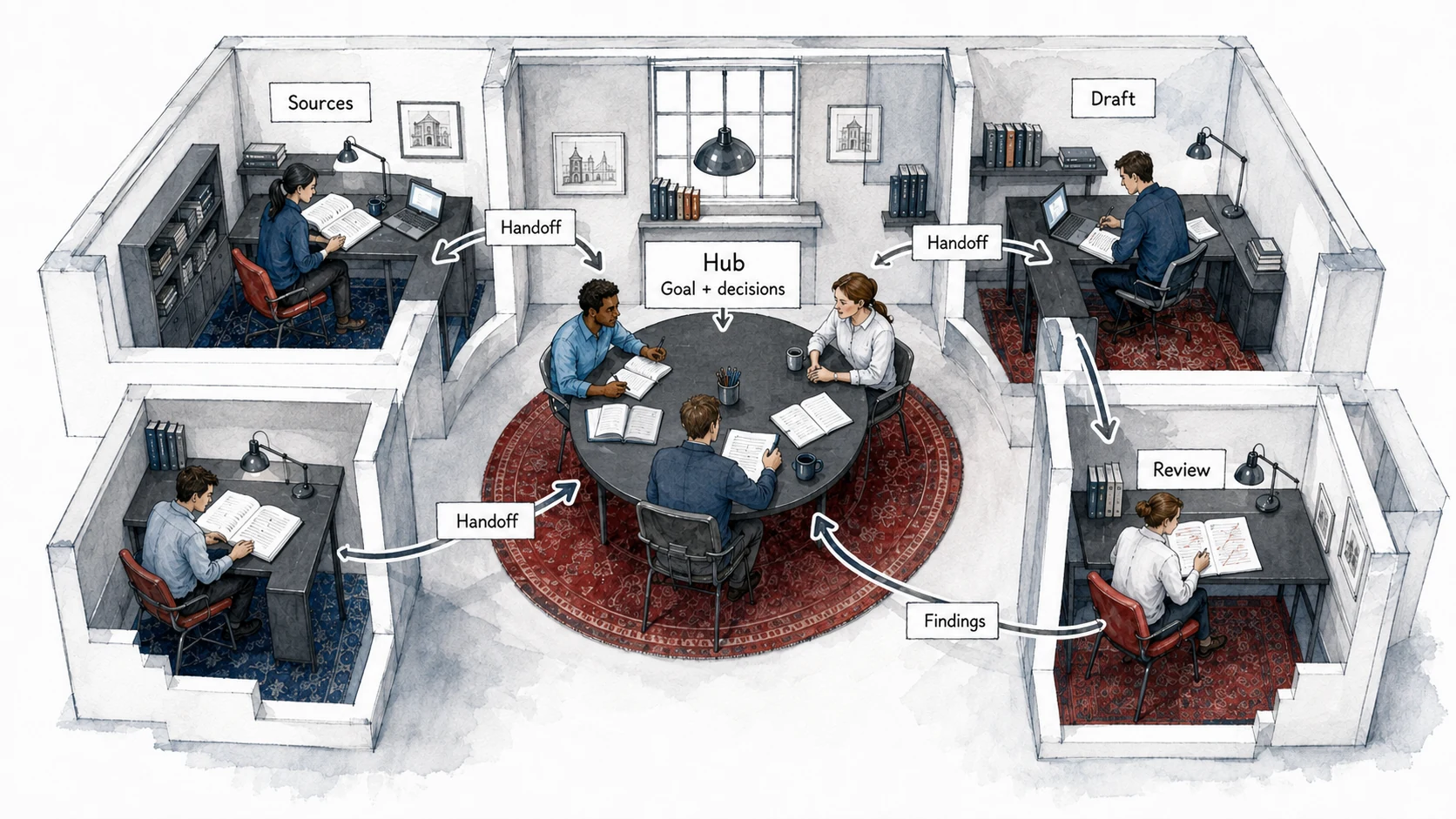
Hold the goal in a hub and give each spoke one assignment
A workflow gives coordination a clear home. One conversation holds the overall task, while each spoke receives an assignment. The pattern is useful when the hub can integrate the returned findings and the spokes can work from well-defined inputs.
The hub holds the current plan. Give it the goal, audience, constraints, and sources. Ask it to identify assignments, dependencies, and how each result will be checked. It can draft a starting proposal if that helps; later synthesis must account for the evidence returned by the spokes.
Each spoke needs a self-contained assignment. In a manual trial, paste the shared brief and the spoke's prompt into a new conversation, then supply the relevant source material there. Ask it to report any source it cannot access. Return its findings, source references, and unresolved questions to the hub. If you later automate the handoff, check that each assignment still receives the intended inputs and returns the evidence needed for synthesis.
Specify what each assignment may decide. A research spoke may report uncertainty; it should not quietly change an agreed budget. A drafting spoke may improve wording while preserving commitments. The hub reconciles their results against the project goals and brings unresolved decisions back to whoever has authority to make them.
Add conversations when a project needs independently verifiable work or a separate review context. Define each assignment and its inputs before opening it. The coordinating conversation reconciles the results. Keep work together when splitting it adds briefing and integration effort without a useful gain.
Follow a proposal from source review to synthesis
Check shared facts, assignment boundaries, and integration
Parallel work can fail in the shared brief, the assignment boundaries, or the integration. The following examples help you diagnose those problems. Each points to a concrete, testable change.
Clear assignments, current shared facts, and deliberate integration address these failures. They do not eliminate them automatically. Ask the hub to check for conflicting versions, unsupported assumptions, and commitments that changed during a handoff before finalizing the result.
A separate review can test what a production pass missed. Give it the draft, criteria, and sources, then verify its findings. A different conversation or model can still share the original error; separation helps only when the check contributes useful evidence.
Reconcile conflicting findings before drafting the recommendation
When findings disagree, ask the hub to compare their sources and assumptions. In the illustrative warehouse pilot, a spoke might estimate savings from the reported hour of copying, while another flags correction work that the records never measured. Presenting either assessment as measured savings would overstate the evidence. The hub can propose measuring both copying and correction time during the trial. Check whether that proposal resolves the uncertainty that matters to the decision, and supply any relevant constraint the hub lacks.
Give the hub the facts that should change its recommendation. A budget limit or commitment already made to a client can determine which proposal is acceptable. Ask the hub to show how those constraints affect its synthesis, then check the reasoning against the source material.
Stay in one conversation when a task fits there
Stay in one conversation when it can complete and check the task reliably. A short email or simple summary often does not justify separate assignments. A focused second review may still help when it catches a consequential error. Let the task and the evidence determine the amount of coordination.
Clarify enough of the goal to assign useful work. Ask the hub to identify the uncertainty, the evidence needed to resolve it, and which investigations can proceed independently. A vague request to "research everything" needs a more specific question before extra conversations can help.
Uncertain inputs need investigation before they support a conclusion. Parallel source checks can help investigate them; parallel drafts that repeat the same unverified assumption will not resolve the uncertainty. Also check whether extra assignments are postponing a decision that already has enough evidence.
Test a coordination plan on independently verifiable project work
Design workstreams around your project’s actual dependencies
Open a coordinating conversation in Claude and bring the project goal and sources. Ask for justified assignments and their handoffs, then test the plan in separate conversations where useful.
- Copy the promptUse the copy button above the box.
- Paste it in Claude or CodexMake sure your active project is enabled.
- Answer the questionsGive clear answers so it understands what you want made.
- Test it to see if it worksTry the output and refine until it does what you need.
Problem: A project may benefit from separate research, analysis, drafting, or review assignments, but their inputs and results need coordination.
Intent: I want to design a hub-and-spoke workflow for my project, using this conversation as the hub and adding separate conversations where they serve a clear purpose.
Ask me for the project, intended audience, goal, constraints, and source material. Use the information I provide and ask focused follow-up questions where a missing fact would change the assignments. Distinguish confirmed decisions from assumptions and open questions. Do not invent my priorities or source findings.
Once you have enough context:
1. Draft a SHARED PROJECT BRIEF with the goal, audience, constraints, confirmed decisions, source references, and required final deliverable. State which sources each assignment will need to receive or access.
2. Propose SPECIALIST or REVIEW assignments where separate context would help. For each, state the purpose, required inputs, output format, checks, and decisions it may make. Explain what separation adds. Keep work in this conversation when a separate assignment offers no clear benefit.
3. Identify dependencies. State which assignments can run concurrently and which must wait. A review of a draft needs that draft; an investigation of the brief's assumptions may begin earlier.
4. Write a self-contained opening prompt for each justified spoke. Include the shared brief and its specific assignment. If required source material is missing, have the spoke request it before drawing dependent conclusions. Tell me what to paste or attach in each conversation and what findings, source references, and unresolved questions to bring back here.
5. Draft a SYNTHESIS PLAN. Explain how this hub will compare returned evidence, resolve disagreements where sources allow, preserve confirmed commitments, and identify decisions or missing information that still prevent a conclusion. Include a check for changed assumptions or outdated versions of the brief.
6. Draft a WORKSTREAM MAP recording the roles, inputs, dependencies, output requirements, and checks. Give me a trial plan for checking the handoffs and comparing the combined result and total effort with a one-conversation approach.
Return the plan and prompts here. Do not launch the assignments or draft the final deliverable. Treat the workstream map as untested until I supply trial results. Use those results to propose improvements, and ask for confirmation before saving a reusable personal workflow.