Becoming an AI Power User
Becoming an AI Power User
30 min leftPage 207 of 223 (est.)
6.4Workflow Redesign, Creativity, and Growth
They turn a private AI workflow into a shared playbook, so a whole team keeps improving and evolving it instead of one person
Developing
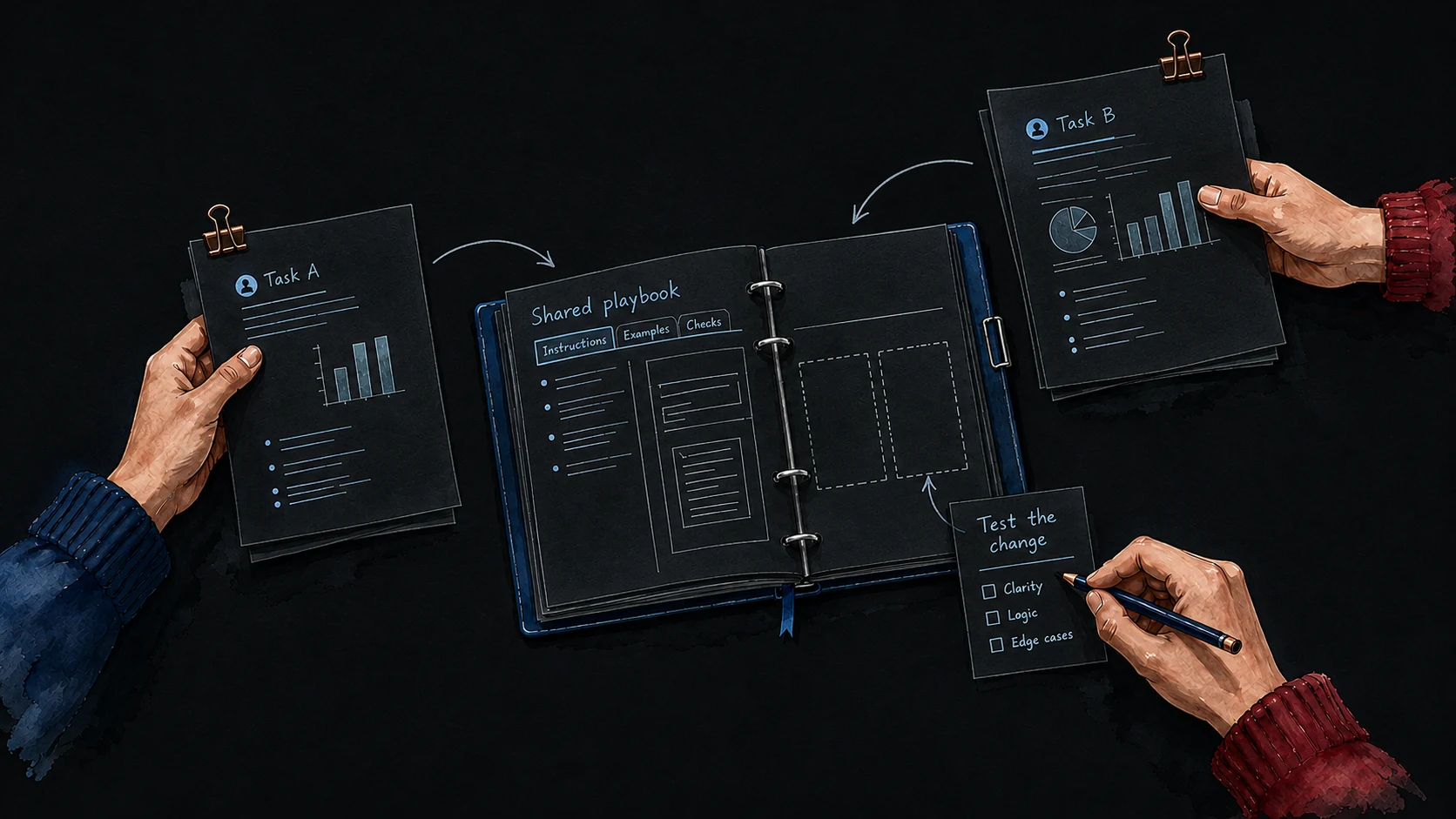
A playbook becomes useful to a team when other people can run it and improve it. Include the instructions and examples that made your result possible, then watch what happens on a colleague's task. Their questions may reveal missing context; their experiments may suggest uses you had not imagined. A shared file is the starting point for that exchange.
Show a useful run and the correction that made it work
A colleague can learn more from a workflow with a visible correction than from a polished output alone. Use an example you are permitted to share, and include the input, the prompt, the result, and the check that mattered. If your organization restricts AI use or particular data, resolve that boundary before proposing a shared trial.
Have AI compare the first and corrected summaries and propose an instruction that explains the difference. Test the instruction on other notes before adding it to the shared playbook. Keep a prior version so a change that fixes one case but damages another can be revised. This is how team feedback can improve later runs.
A demonstration can reveal decisions missing from the playbook
A saved prompt can omit the decisions around it. During a screen share, a colleague might explain why they paused to confirm an assignment or checked a quotation against its source. Ask about those decisions while the input and output are visible. With permission, notes or a transcript can help AI draft the missing instructions for the playbook.
Etienne and Beverly Wenger-Trayner describe communities of practice through a shared domain, relationships among participants, and a body of practice they develop together. For AI-assisted work, that might mean colleagues returning to the same meeting-summary workflow, comparing cases, and revising their shared examples. Regular contact helps create opportunities to learn, but useful cases and candid feedback give those meetings substance.
A reusable playbook records the decisions behind its steps
A reusable workflow needs the decisions behind its steps. In the meeting-summary example, the instruction to distinguish conditional offers from confirmed assignments belongs beside the prompt and checked examples. A colleague or agent can then apply that distinction on another meeting, while you check whether it still holds. Sharing gives you a reason to articulate such decisions. A study by Nestojko and colleagues (opens in a new tab) found better recall and organization of text material among learners who expected to teach it. That was a reading experiment, so its application to documenting an AI workflow is a teaching rationale to test, not a measured productivity effect.
Sharing adds perspectives as well as test cases. One colleague may use the meeting-summary playbook on a planning session, another on a short client call, and another may explore a new way to present the open questions. Ask AI to compare permitted examples against the quality standard and propose improvements. Have someone own the saved version and test changes before replacing it, so competing suggestions do not leave the team with contradictory instructions.
A colleague’s independent trial reveals missing instructions
One manageable starting point is to document a workflow and invite a colleague to try it. A playbook does not need to be comprehensive. It needs to answer three questions: what task does this workflow handle? What does the AI setup look like? What quality checks do you apply?
A good playbook is specific enough that someone can follow it without guessing. It includes the actual prompts, complete and ready to paste, the model selection, the reference materials, and the verification steps. A test of a good playbook is whether a colleague can meet the same quality standard on a new example without you in the room.
Visibility without governance creates a different kind of risk
A shared workflow needs agreed conditions for use. Colleagues need to know which tool may receive the task's data, which checks the output requires, and when to disclose AI assistance. Documenting the prompt leaves these questions open unless the playbook also records the relevant policy.
Before sharing an AI workflow with a team, document four rules:
- Approved tools. Which AI tools are allowed for this workflow? Some organizations have data-processing agreements with specific vendors. Others prohibit certain categories of data from leaving the org. Know the boundary.
- Data boundary. What information may never be pasted into AI tools? Client names, financial figures, health data, employee records, legal correspondence, and anything covered by NDA or regulation should have an explicit rule.
- Review standard. Which source checks, automated checks, or qualified reviewers must assess the output before it is used? Name the quality criteria and any decisions that require a person's approval.
- Disclosure norm. When should the team say that AI helped produce the work? Some organizations require disclosure on client-facing deliverables. Others are more informal. A shared norm prevents awkward situations where one person discloses and another does not.
For the meeting-summary playbook, those rules might specify the approved assistant, which meeting notes it may read, how decisions are checked against the transcript, and who may receive the summary. Fill in the rules from your organization's policy; do not let AI invent an approval or a data-handling promise.
How to have the AI conversation with your team
If your organization does not yet have an explicit AI policy, raising the topic can feel risky. A small proposal can make the discussion concrete:
- Show the result and how it was produced. Use an approved example, explain AI's role, and show the quality check that caught or prevented an error.
- Propose a bounded trial. Agree on the workflow, allowed data, participants, success criteria, and review date. Ask the appropriate owner to clarify policy before the trial starts.
- Choose a workflow with shared demand and repeated effort. Choose a recurring task such as meeting summaries or client preparation. Compare effort and quality on representative cases, then use the findings to decide whether to extend the trial.
Share a workflow that colleagues need and can verify
Turn one AI workflow into a shareable team playbook
Claude asks about a workflow that has worked for you and drafts a concise playbook with prompts, quality checks, and known team rules. You check the account before sharing it for a colleague's trial.
- 1Copy the promptUse the copy button above the box.
- 2Paste it in Claude or CodexMake sure your active project is enabled.
- 3Answer the questionsGive clear answers so it understands what you want made.
- 4Test it to see if it worksTry the output and refine until it does what you need.
Problem: A colleague may need context and judgment that my saved prompt leaves out.
Intent: I want to document a workflow that has worked for me so a colleague can try it and help improve it.
Ask which workflow other people would find useful. Request my actual prompt or conversation, relevant setup and reference materials, an example result, and the checks or corrections I used. If I can only describe the workflow, distinguish that account from an inspectable run record.
Interview me in short exchanges about missing details: what the task handles, tool and model, saved context, follow-up questions or revisions, common failures, and how I decide the result is usable. Ask only for details needed to explain or test this workflow.
1. Draft a concise playbook with the task, setup, required inputs, copy-ready prompt or prompt sequence, follow-up questions, quality checks, and tips supported by my experience. If the prompt needs material from its user, have it ask for that input. Keep proposed improvements separate from the workflow I have actually used.
2. Use an example and correction I can share to explain a consequential check. Keep private client, personal, financial, health, legal, or identifying details out of shared examples. If a fictional illustration is needed, label it and preserve the behavior being taught; never present it as evidence from my work.
3. Ask for the relevant organization policy or rules I know. Record approved tools, permitted data, required review, and disclosure expectations. Mark missing policy as a question for the appropriate owner; do not invent approval or a data-handling promise.
4. Identify unclear steps and assumptions a colleague would need resolved. Ask for missing answers before presenting the affected instructions as ready to use.
5. Draft feedback questions for a colleague's trial: could they follow the steps, did the result meet the same quality standard on their task, and what needed correction? Suggest retaining the test cases and a prior playbook version when evaluating later changes.
Scope: draft the playbook and trial questions only. Do not change the workflow, save files, or share anything. Base any personal preferences or habits in the draft on my actual material, show their support, and wait for my confirmation before any later saving.
AI PracticeAct
Opus 5.5References
1 source- 1
Etienne Wenger-Trayner, Beverly Wenger-Trayner · 2015 · wenger-trayner.com
The authors distinguish a community of practice from a shared website or interest: participants learn together and develop resources for recurring problems.
AI power-user development has the same structure: a shared domain (AI-assisted work), a community (colleagues or peers), and a practice (the workflows, prompts, and judgment calls that improve through comparison). The framework suggests what to organize around: shared tasks, interaction, and examples people can use and revise.
This is a conceptual introduction, not a study measuring the effectiveness of AI playbooks. Applying it to a screen share or prompt exchange is an analogy to assess: participants still need a shared domain, interaction, and a practice they develop together.